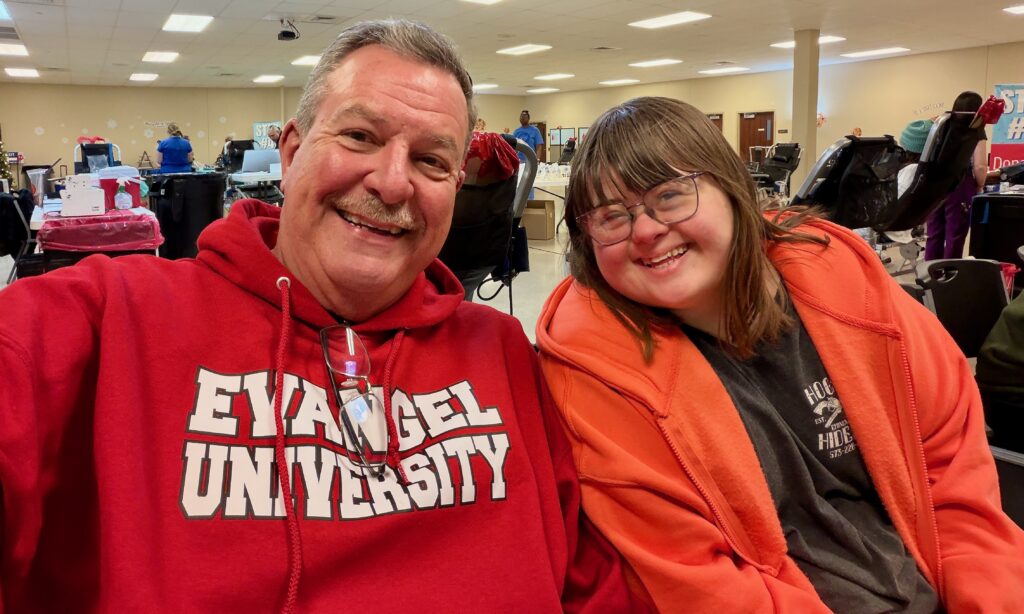

Shelby Twigger hates to miss work.
After attending a retirement event with her dad, Doug, in summer 2024, she insisted on going back for the final hour and a half of her shift at Christian County Enterprises in Nixa, where about 60 Missourians with disabilities take on contract work for businesses across the state.
Shelby, 25, is from Rogersville and has Down syndrome. She told The Independent her current favorite assignment right now is preparing plastic worms to be sold as fishing lures in Bass Pro Shops. She and her co-workers separate the worms, which come out of a mold stuck together, and package them in groups of 10, 18 or 20.
“She’s with her people, she’s with her friends,” Doug Twigger said. “They laugh, and they talk, and they have a good time. But they’re also productive while they’re there.”
Voters in 97 Missouri counties will weigh in during Tuesday’s municipal elections on measures that would cap property taxes.
The measures, if approved by voters, would limit local revenue used to fund public schools, fire and emergency departments, libraries — and an array of services for Missourians with developmental disabilities.
Christian County Enterprises receives property tax revenue through CC Links, one of 90 county developmental disability boards in the state. The board relies on property taxes to fund cooking and exercise classes, driver’s education and life coaching.
“Those services are huge in our world,” Twigger said. “They’re valuable. I can’t place a price tag on the value that’s received from those.”
The property tax changes put before voters are the result of a 2025 bill that state lawmakers passed in June hoping to entice the Kansas City Chiefs and Royals to stay in Missouri.
Alongside incentives for both teams to build new Missouri stadiums was a proposal to limit future increases in what Missourians owe in property taxes. Taxpayers in 75 counties would owe no more than 5% more than their property tax liability for the 2024 tax year. In 22 counties, taxpayers’ property tax liability would be frozen at their 2024 amount. The amount taxpayers owe would be adjusted to reflect new construction on their property.
Six school districts, a fire district and two Missouri residents are suing the state, arguing that the law arbitrarily distinguishes between counties where property taxes would be frozen, capped or left unchanged.
“Individual legislators were allowed simply to dictate how their county would be designated within the bill,” the lawsuit states.
State Auditor Scott Fitzpatrick noted in his report on 2025 property tax rates that “the bulk of property taxes…fund public schools.”
“General acceptance of these taxes is dependent on fair and equitable assessment practices and public understanding and input regarding the setting of rates,” he wrote.
A 1969 state law allowed counties to establish property tax levies to fund local services for people with developmental disabilities, as well as local boards to distribute the funds. For the 2025 tax year, Christian County’s board is expected to receive almost $1.5 million in property tax revenues, from a levy of .0728 cents per $100, according to a report by the Missouri State Auditor.
It’s not clear how much revenue county developmental disability boards could lose due to the measures before voters. But if property values continue to rise faster than inflation across much of the state, counties that approve Tuesday’s ballot measures are likely to lose revenue.
In 2025, property value assessments increased faster than the rate of inflation in all but 11 Missouri counties, according to the auditor report, or 32 counties when adjusting for property improvements and changes from locally to state-assessed property. That’s a marked increase from 2024 and 2023.
Nancy Pennington, executive director of the Missouri Association of County Developmental Disability Boards, told The Independent that the revenue losses would weaken a key part of the state’s system of developmental disability supports at a time when other services are also under threat.
The Missouri House restored $28.1 million of the $28.6 million in general revenue cuts to state developmental disability services recommended in Gov. Mike Kehoe’s fiscal year 2027 budget plan, after more than 1,000 family members, caregivers and Missourians with disabilities pleaded with lawmakers to maintain the services. The future of this funding is still uncertain, with the House budget in the hands of the Senate Appropriations Committee for potential amendments.
The House budget also includes no money to fund Missourians newly qualifying for home and community-based services, which means that the waitlist for services will likely grow.
Pennington said the county boards “fill in the gaps” for people with disabilities who don’t meet requirements for state programs.
The programs that Kehoe had identified for cuts, administered by the Missouri Department of Mental Health and funded through Medicaid, allow people with disabilities or their families to hire care staff or enroll in day programs so that they can live safely in their homes.
“Some people don’t need that much, or some people are not eligible for Medicaid,” Pennington said.
County boards provide case management to people who don’t receive it from the state because they don’t qualify for Medicaid, Pennington said. Some boards provide transportation services on evenings and weekends, when public transportation isn’t operating.
Pennington said that as state funding for disability services constricts, Missourians will increasingly look to the county boards.
“As it’s limited, more and more people are going to come to the county boards and hope for support,” Pennington said. “We’re being attacked on all fronts right now.”
Doug Twigger said he worries a property tax freeze would force organizations like Christian County Enterprises to cover rising costs with stagnant revenue.
And he said he wants voters to understand that everyone benefits from many of the services funded by property taxes — like local fire departments.
“That’s to my house, and that’s to your house,” Twigger said. “And that’s to the Smiths’ house.”
“My concern is the population is going to say, ‘Heck yeah, let’s freeze our taxes,’” he said, “and not realize what services are being cut.”