

The post What Backyard Hawk Photos Reveal About the Birds They Hunt Most appeared first on A-Z Animals.
Quick Take
-
Researchers at the University of Kentucky turned to the platform iNaturalist for data on two hawk species.
-
They examined nearly 80,000 images of Cooper’s hawks and sharp-shinned hawks submitted by citizen scientists.
-
They determined that other birds are the primary targets for both species.
-
Cooper’s hawks favor larger birds, like rock pigeons, while sharp-shinned hawks like smaller prey, like European starlings.
Researchers don’t often turn to the general public for help with scientific studies. However, for scientists seeking to better understand the dietary habits of two hawk species, involving citizen scientists was a logical choice.
After all, who is better equipped to document a hawk’s hunting behavior than homeowners with backyard bird feeders? These feeders attract both Cooper’s hawks and sharp-shinned hawks by drawing in their favorite prey, such as doves, pigeons, starlings, and sparrows.
At least that’s what the results of a new study from the University of Kentucky Martin-Gatton College of Agriculture, Food and Environment revealed.
More About the Study
Researchers in the Department of Forestry and Natural Resources (FNR) at the University of Kentucky conducted their research by analyzing thousands of photos shared on the iNaturalist platform. The platform is used by nature lovers to record, share, and discuss their observations of plants and animals in the natural world. That data is then made available on data repositories like the Global Biodiversity Information Facility, where scientists can access and utilize it.

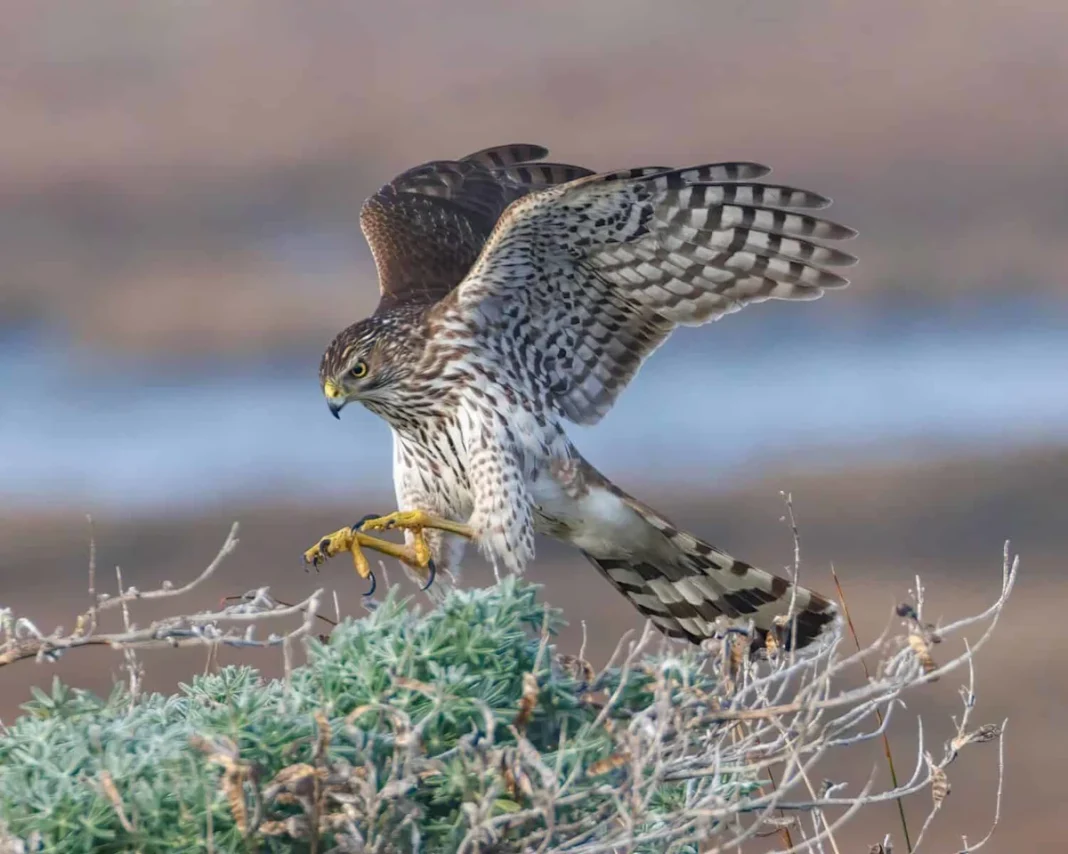
The Cooper’s hawk was one species studied by researchers.
©michaelschober/Shutterstock.com
(michaelschober/Shutterstock.com)
The scientists involved in this study focused on images of two specific hawk species: the Cooper’s hawk, Astur cooperii, and the sharp-shinned hawk, Accipiter striatus. Both species are quite common in residential neighborhoods, where backyard bird feeders are often present.
Overall, the researchers reviewed 74,974 photographs of the two hawk species across the birds’ natural range. The researchers identified thousands of hunting interactions between the hawks and their prey. They discovered that both species’ diets consist mostly of other, smaller birds. This information filled a gap in scientific knowledge about these two raptor species. Although the hawks are often seen, little was known about their actual hunting preferences.

The sharp-shinned hawk, the smaller of the two hawks, was also studied.
©Vizz Effect/Shutterstock.com
(Vizz Effect/Shutterstock.com)
Will Gibson, a first-year Master’s student in FNR who helped lead the study, said in the recent press release announcing the results, “We were very excited to explore the opportunities citizen science provides to the field of wildlife research, especially for two common backyard birds. Citizen science platforms like iNaturalist offer an incredible glimpse into the lives and behaviors of wildlife that may otherwise be understudied.”
Darin McNeil, assistant professor of wildlife management at Martin-Gatton CAFE, confirmed the importance of citizen scientists for this study. He said in the same press release, “There’s a lot of information out there from citizen scientists that had not really been analyzed in this way, and we were able to use that to learn what these hawks are actually choosing to eat.”
What Did the Study Find?
Two main findings came out of the study. One is that Cooper’s hawks, the larger of the two species, prefer larger prey like pigeons and doves. Researchers found that Cooper’s hawks chose rock pigeons, mourning doves, and other dove species more often than would be expected based on the available prey. Of course, Cooper’s hawks also eat mammals, but photographic evidence showed that the hawks prefer birds.

Rock pigeons are the favorite prey of Cooper’s hawks.
©Opasbbb/Shutterstock.com
(Opasbbb/Shutterstock.com)
The other finding was that sharp-shinned hawks preferred birds to any other prey even more. Images of these hawks in action showed that nearly all of their prey were birds, most often European starlings, house sparrows, and mourning doves. Researchers only identified one instance among the nearly 80,000 photographs where a mammal was the sharp-shinned hawk’s prey.
“We were actually surprised by how bird-focused the sharp-shinned hawk was,” McNeil said in the press release. “There are reports in the literature of them eating mammals, but in our data we found almost no evidence for that.”
The study’s findings support the long-held scientific belief that both hawk species mostly hunt other birds. The study also revealed that the two hawk species prefer different sizes of prey. Cooper’s hawk prey averaged 5.8 ounces, while sharp-shinned hawk prey weighed in at two ounces on average.

European starlings are the preferred prey for sharp-shinned hawks.
©iStock.com/chris2766
(iStock.com/chris2766)
However, among both hawk species, doves appeared to be a particularly preferred meal. Researchers note that doves are large, provide a substantial meal with a single kill, and are usually found in open spaces, making them easier for hawks to hunt successfully. They also pointed out that doves are less able to defend themselves once caught by a hawk.
It also seems that each hawk has its own favorite meal. For the Cooper’s hawk, it‘s rock pigeons. Sharp-shinned hawks choose European starlings. Mourning doves come in a close second for both hawks.
The study supports previous findings that Cooper’s hawks have become more common in suburban and urban areas over recent decades. Researchers note that the shift is a reason citizen scientists are seeing them more often at bird feeders and in neighborhoods.
The Critical Role of Citizen Scientists
This research project would not have been possible without the regular contributions from nature lovers and backyard birders. Nearly 80,000 uploads to iNaturalist were done primarily by everyday citizens with an interest in birds.

Citizen scientists were the driving force behind the study.
©A-Z Animals
(A-Z Animals)
These records formed the foundation of the study and helped researchers gain a broader understanding of hawk behavior in urban settings. The images revealed how hawks interact with prey not only at bird feeders but also in larger backyard spaces where birds like pigeons are commonly found. This broader perspective provided more detailed information than historical data, which focused only on nests or bird feeders.
“By expanding the types of data that can be garnered from citizen science, we have shown how useful citizen science is as a tool,” Gibson said in the press release. “This just shows how important everyday people are to the field of wildlife research.”
The post What Backyard Hawk Photos Reveal About the Birds They Hunt Most appeared first on A-Z Animals.