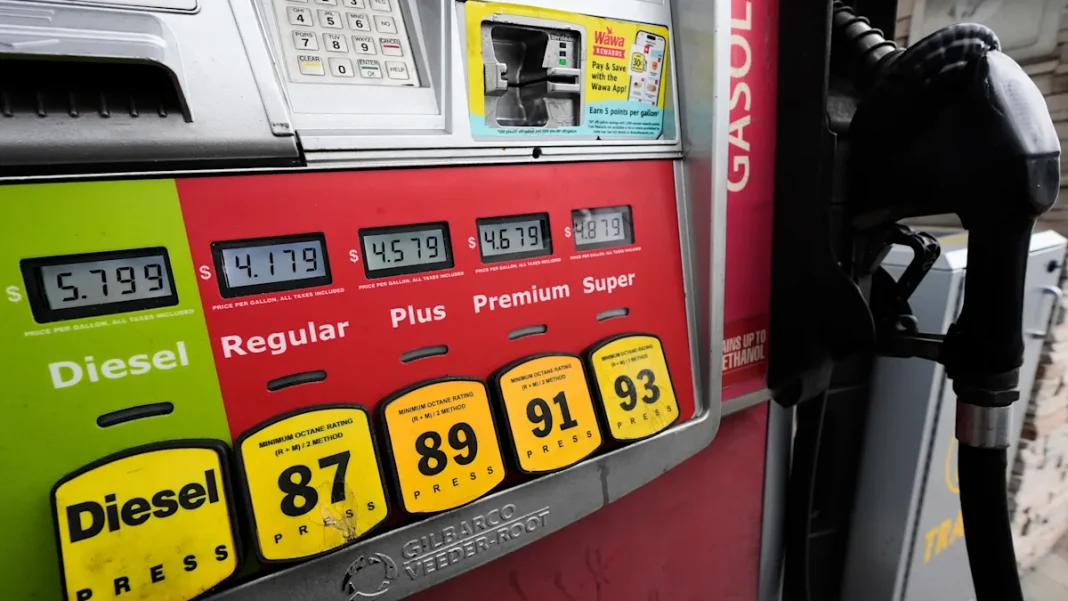

In the hours before President Trump announced a temporary ceasefire with Iran on Tuesday, the average gas price in the United States edged up to $4.14 per gallon of regular fuel, according to AAA.
Two days later, that price — now $4.17 per gallon — is still rising.
Millions of cash-strapped Americans are probably hoping that the current ceasefire — a two-week pause to hammer out a lasting peace deal — will mean a swift return to where gas was before the U.S. and Israel went to war with Iran on Feb. 28: under $3 per gallon.
After all, haven’t the Iranians agreed as part of the ceasefire to lift their month-long blockade of the Strait of Hormuz, which has effectively choked off one-fifth of the world’s oil supply? And if oil starts flowing out of the Persian Gulf again, doesn’t that mean gas prices will plummet?
Unfortunately, no — or at least not anytime soon.
“There’s no going back to what we had,” Mark Zandi, chief economist of Moody’s Analytics, told USA Today. “At least not this year.”
Here’s why you can expect more pain at the pump in the weeks and months ahead.
Has the Strait of Hormuz really reopened?
The international benchmark for oil prices is called Brent crude. Brent is a type of oil, mostly from the North Sea. Traders effectively place bets on the future price of oil by buying and selling Brent futures on financial markets, which in turn affects the price of oil itself. Real-world events drive their decisions to buy or sell.
When Iran closed the Strait of Hormuz, oil prices rose. If Iran reopens the strait, oil prices should theoretically fall. Brent crude is easy to refine into gasoline, so gas prices tend to rise and fall along with Brent prices.
But the problem is that the Strait of Hormuz hasn’t actually reopened yet — and there are serious doubts about what “reopening” means exactly (not to mention how long it might last).
Just hours after Trump announced the ceasefire, for instance, Iranian state media said Tehran had turned some tankers away and “fully closed” the strait again. Semi-official outlets affiliated with Iran’s Revolutionary Guard reported that the strait’s closure came in response to a deadly wave of Israeli attacks in Lebanon.
There’s been some confusion over whether Hormuz is currently closed or open. Iran seems to have stopped laying mines and attacking vessels, and the regime has said it will allow for safe passage if ships coordinate with the country’s armed forces. At the same time, Tehran is insisting that if the Strait of Hormuz is to fully reopen, Israel must stop bombarding the Iranian-backed militant group Hezbollah in Lebanon — a contentious issue that threatens the ceasefire. Finally, the regime is also demanding formal control over the strait going forward, with a reported toll of $2 million per vessel.
These kinks could be ironed out by negotiators who are meeting in Pakistan over the weekend. Governments in Europe and Asia have said they will eventually “contribute to ensuring freedom of navigation.” And even though Trump said on Wednesday that the U.S. might join Iran in charging a Hormuz toll as “a joint venture,” by Thursday, he was adamant about them not doing so on their own.
“There are reports that Iran is charging fees to tankers going through the Hormuz Strait,” the president wrote on social media. “They better not be and, if they are, they better stop now!”
The bottom line, however, is that few ships are willing to risk transiting the Strait of Hormuz in the meantime. In fact, Wednesday saw the lowest ship traffic through the strait since late March, according to data from Kpler, a global ship-tracking firm. Just five bulk carriers made the trip; no oil or gas tankers joined them. Before the war, more than 130 ships typically crossed the strait each day.
The ceasefire is “too unstable for anyone to commit,” one maritime insurance executive told the New York Times. Until those ships start moving and Gulf oil comes back online, there’s no chance of U.S. gas prices going down.
‘Up like a rocket and down like feather’
Assuming the Strait of Hormuz does fully reopen sometime soon — a big assumption given all the diplomatic challenges ahead — experts say prices at the pump still won’t plunge to their prewar level.
“There’s an old expression: Gas prices go up like a rocket and come down like a feather,” one independent oil analyst told CNN.
In the case of Iran, five factors will continue to pad the price of gas even after the end of the war.
First, oil production has largely ground to a halt across the Persian Gulf over the past six weeks — partly because the region’s oil infrastructure suffered damage and partly because countries such as the United Arab Emirates, Kuwait, Iraq, Oman and Saudi Arabia (the world’s largest oil exporter) ran out of storage space. An estimated 7.5 million barrels of production per day were shut down in March, according to the U.S. Energy Information Administration. Global supply will continue to suffer while these countries play catch up — a process that could take years, experts say.
Second, exporting oil from the Gulf will get more expensive if Iran charges a toll, and that added cost — an estimated $1 per barrel, according to CNN — is likely to be passed on to consumers.
Third, insurance for ships that cross the Strait of Hormuz will likely cost more as well — another expense that could make gas and other petroleum products pricier for Americans.
Fourth, “traders will want some premium to compensate for [the] risk” that the “ceasefire breaks,” according to Zandi. That’s why oil futures are still above prewar levels through the end of 2026.
Finally, retail gas station owners set their prices based on the wholesale price of gas. When oil gets more expensive, that price goes up — but gas stations tend to accept a smaller profit margin on each gallon they sell in order to stay competitive. Then, when the cost of oil starts to fall, they typically try to even things out by hanging onto higher gas prices for as long as possible.
The U.S. now produces more oil than any other country on earth. But it also consumes more, and even though very little of America’s oil is imported from the Persian Gulf, the market is global — meaning everyone is competing for the same barrel of oil. So prices rise everywhere at once.
Over the past few days, they have nosedived from about $110 to about $90 a barrel on news of the ceasefire, then rocketed back to about $100 amid fears that it could fall apart. Until those numbers stabilize, U.S. gas prices will remain stubbornly high.
And even if they do start to fall, it could take until next year for them to slip under $3 again.