
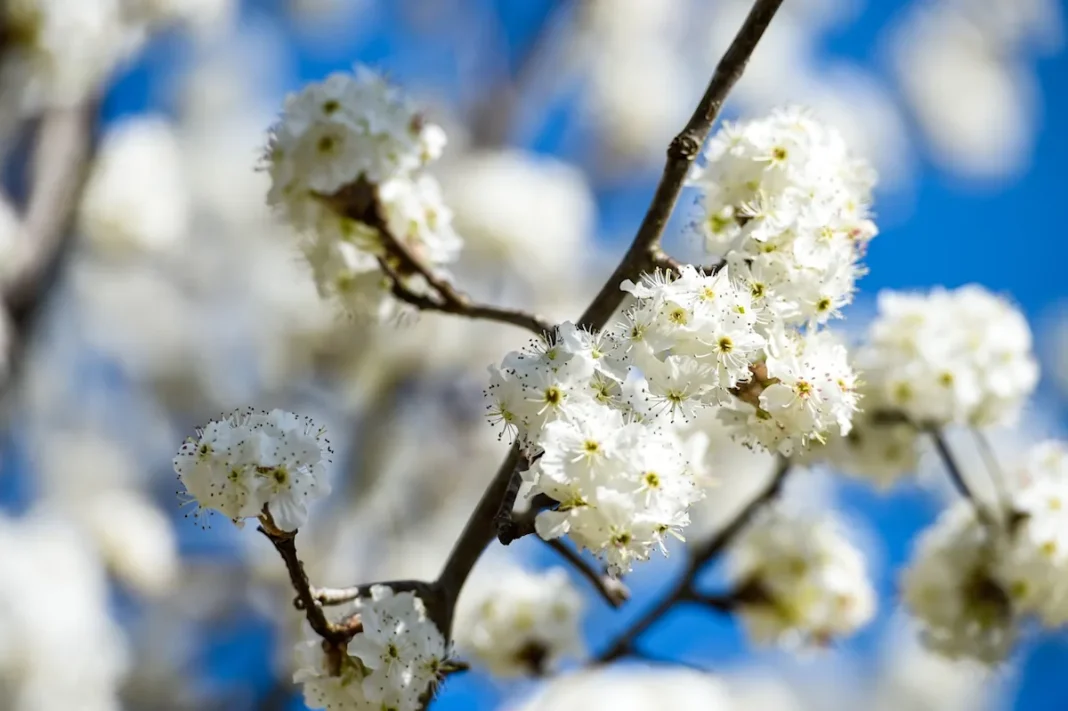

It’s that time of year again, when Bradford pear trees spread a fishy, chlorine‑like smell across New Jersey neighborhoods.
Under a new law, the Bradford pear tree and 29 other nonnative plants that harm local ecosystems, pose public safety risks and create nuisances will be banned in the state. (See the full list of banned plants below.)
Then-Gov. Phil Murphy signed the law, S1029, shortly before he left office in January. The law says the Bradford pear trees and other banned plants must be phased out over time.
Starting 13 months after the law was signed, no one may propagate or import any of the banned plants without a waiver. In four years, the ban expands to forbidding anyone from selling, distributing or exporting the banned plants or their seeds.
The law does not say existing Bradford pear trees or other banned species need to be cut down or destroyed.
Prone to breaking apart in storms and infamous for their pungent smell, Bradford pear trees have become a recurring headache for many New Jersey residents.
Complaints from residents and environmental groups pushed lawmakers to ban the trees. The trees also have a reputation for crowding out native species that other animals depend on for shelter and sustenance.
The state Department of Environmental Protection and the Department of Agriculture will be responsible for enforcing provisions of the law related to sales and distribution.
The law also targets dozens of other invasive plants, including English ivy and buckthorn.
Although retail sales will not become illegal until 2030, the law has already designated the creation of a statewide council to focus on the effort.
The banned species include:
-
Norway maple (Acer platanoides)
-
Tree of heaven (Ailanthus altissima)
-
Mimosa tree or Persian silk tree (Albizia julibrissin)
-
Porcelain berry (Ampelopsis glandulosa var. brevipedunculata)
-
Japanese angelica tree (Aralia elata)
-
Japanese barberry (Berberis thunbergii)
-
Japanese clematis (Clematis terniflora)
-
Autumn olive (Elaeagnus umbellata)
-
Weeping lovegrass (Eragrostis curvula)
-
Winged burning bush (Euonymus alatus)
-
English ivy (Hedera helix)
-
Japanese hop (Humulus japonicus)
-
European privet (Ligustrum vulgare)
-
Amur honeysuckle (Lonicera maackii)
-
Morrow’s honeysuckle (Lonicera morrowii)
-
Purple loosestrife (Lythrum salicaria)
-
Japanese crabapple (Malus toringo)
-
Chinese silver grass (Miscanthus sinensis)
-
Eurasian water-milfoil (Myriophyllum spicatum)
-
Oriental photinia (Photinia villosa)
-
Callery or Bradford pear (Pyrus calleryana)
-
Common buckthorn (Rhamnus cathartica)
-
Jetbead (Rhodotypos scandens)
-
Multiflora rose (Rosa multiflora)
-
European water chestnut (Trapa natans)
-
Siebold’s arrowwood (Viburnum sieboldii)
-
Japanese wisteria (Wisteria floribunda)
-
Chinese wisteria (Wisteria sinensis)
-
Sericea lespedeza (Lespedeza cuneata)
-
Running bamboo (Phyllostachys)
Read the original article on NJ.com. Add NJ.com as a Preferred Source by clicking here.