
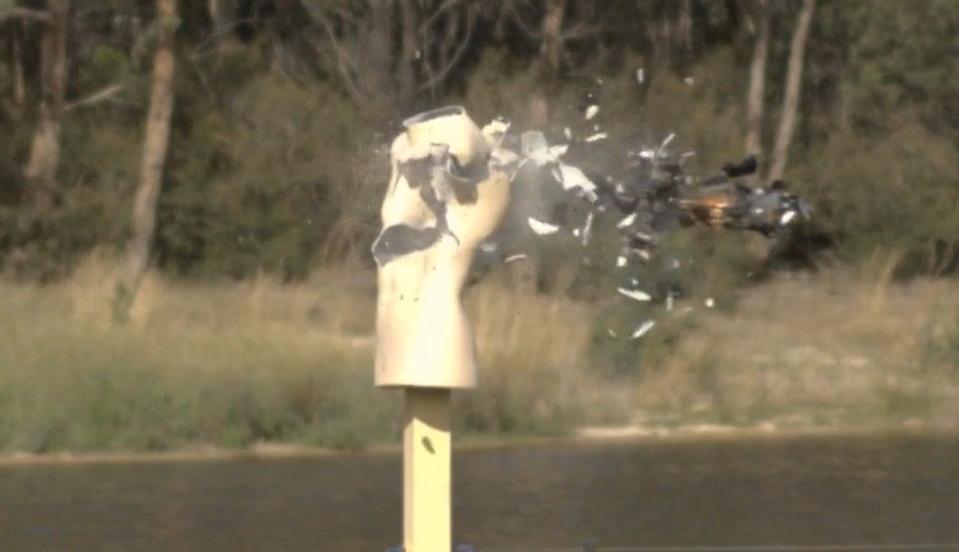

A video shared online shows a high-speed attack drone with no warhead taking out a human dummy with a sharp blade. Samuel Cardillo, CEO of ShadowBreak Intl, who posted the video describes it as a “Flying Sword” which attacking at 450 kph / 280 mph.
Demonstrations always look impressive and may be highly misleading. But the Flying Sword highlights a new trend in attack drone technology which will make FPVs harder to stop, and more accessible to governments and non-state groups alike.
Gladiators Of The Sky
In Ukraine, drone versus drone warfare has already seen a wide range of gladiatorial weapons used, including drones fitted with lances, tridents and harpoons. These are effective because the targets are fragile plastic and carbon fiber. To bring a quadcopter down, all you need to do is break a rotor blade, and a fishing rod with a cord can do the job.

A Russian FPV interceptor with a trident closes in on a Ukrainian drone
Russian MoD via X
Ground targets are much tougher , which is why FPVs carry explosives. Originally these were repurposed RPG rounds, but in the last couple of years a wide variety of FPV munitions have been fielded for different targets.
There are many videos online of other Flying Sword drones, made in imitation of weapons from Chinese mythology, and even a fleet of them operating in unison. But these are toys with foam or plastic blades.
At least one video has emerged from Ukraine of an FPV armed with a Japanese sword. This looks more like a cool demonstration of maneuverability with an awkward payload than a serious weapon.
ShadowBreak’s Flying Sword appears entirely serious. And the numbers suggest that it really is lethal.
The bolt from a hunting crossbow weighs about 35 grams and travels at 350 kph, and can easily kill a deer. A medieval longbow arrow was heavier at about 80 grams but only reached about 220 kph. The Flying Sword is significantly faster and weighs at least ten times as much as either.

The Roman ballista was an earl6y form a field artillery launching heavy projectiles at high speed
Universal Images Group via Getty Images
To find anything comparable you have to go back to the Roman ballista, a giant crossbow used as battlefield artillery which threw a meter-long, 500-gram bolt at 360 kph. A direct hit was devastating, as chronicler Procopius noted in his History of the Wars, describing how a Goth archer protected by a chainmail shirt or corselet was struck during the siege of Rome:
“…passing through the corselet and the body of the man, the missile sank more than half its length into the tree, and pinning him to the spot where it entered the tree, it suspended him there a corpse,” Procopius wrote.
Flying Sword would be even more lethal, assuming we accept the 450 kph figure. In Ukraine, most FPVs are slower, as videos of them gradually catching up with fleeing motorcyclists demonstrate. Some FPV interceptors, which have similar bullet-like aerodynamics as the Flying Sword, have a quoted speed of over 300 kph / 186 mph. And racing FPVs are faster still, with some exceeding 600 kph / 370 mph. So 450 kph is plausible.
The Impact Of Speed

The multibladed point of the Flying Sword
ShadowBreak Intl via X
Cardillo says that the company is also working on a version with an explosive warhead. But the non-explosive version is also significant. Its main use may be in intercepting drones, cruise missiles, helicopters and other aerial targets. The drone features autonomous terminal guidance, which seems essential given the high approach speed, and the production version should have a battery life of at least eight minutes.
In terms of ground targets, Flying Sword may be effective against personnel, but useless against tanks, artillery and other vehicles which explosive FPVs can destroy with ease. It has two significant advantages though.
One is the lack of “collateral” damage. The U.S. has an R9X version of the AGM-114 Hellfire missile in which the explosive is replaced with six pop-out blades, nicknamed with “Ninja Missile” or “Ginsu Missile”. This is used for targeting killings of suspected high-ranking terrorists. The Hellfire weighs 100 pounds and costs around $100k ; Flying Sword offers the same sort of lethality in a portable, low-cost package.

The Sting interceptor from Ukrainian Wild Hornets illustrates the size and shape of modern high-speed drones
Wild Hornets
More significantly, this type of technology would be interesting to groups who do not have military munitions and cannot build reliable improvised explosives. The Flying Sword is effectively a fast racing drone with a blade, something any FPV hobbyist could copy. This creates a precision weapon with a range of several miles that can bypass walls, fences and other security barriers,
Robert Bunker of C/O Futures LLC has written extensively on the criminal use of commercial drones, and notes that as FPVs get faster the Flying Sword-type designs become attractive.
“A criminal or other group can do a whole bunch of damage with kinetic-only drones,” Bunker told me. “More mass and speed mean more damage.”
As well as being used against people, this type of drone might be used against vulnerable targets, such as commercial aircraft.
“Drones have more mass and speed than birds and would do more damage to cockpits or punch through wings,” says Bunker.
Such drones will be harder to stop than standard FPVs because they give so little warning. A kinetic drone launched from five miles away will strike its target in one minute and may travel at very low altitude. This gives little opportunity to detect, locate, identify and intercept the drone before it strikes.
ShadowBreak International have not responded to a request for further information, and have not commented on when Flying Sword will be available. The demonstration suggests development is at an advanced stage.
Kinetic attack drones may not catch on. But they do present a new type of threat in and out of war zones.
This article was originally published on Forbes.com