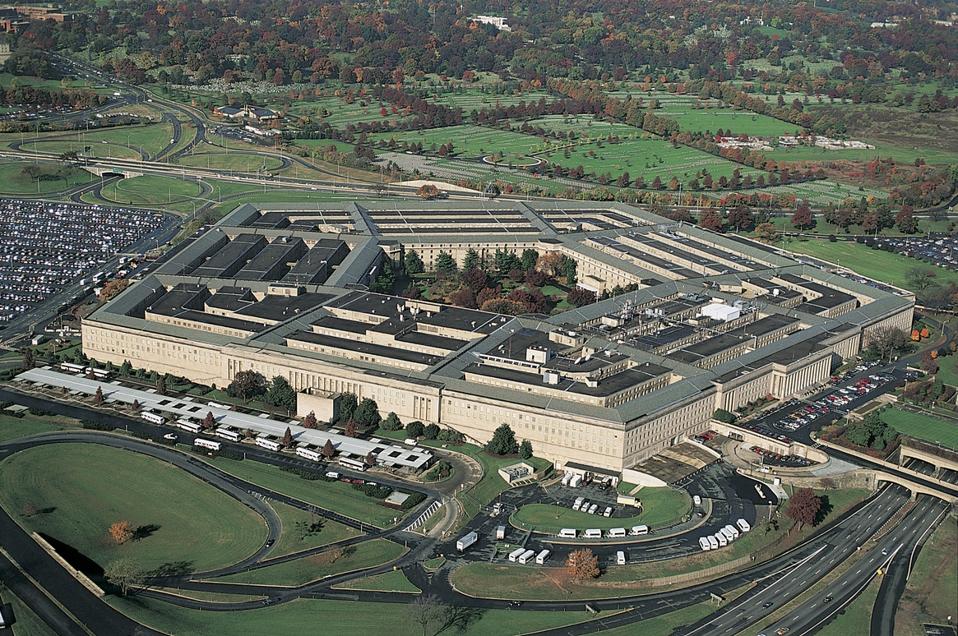
Anthropic’s clash with the Pentagon has become a live market test of whether ethical AI can survive political pressure and procurement realities.
getty
A federal judge ruled this week that the Pentagon’s moves against Anthropic “appear designed to punish” the company for its views on AI safety. That is not a minor legal footnote. It is a signal flare about the state of ethical AI in America—and what it costs a company to mean what it says. In a 43-page opinion, Judge Rita Lin also warned against “the Orwellian notion” that an American company could be branded a potential adversary or saboteur simply for disagreeing with the government.
That question matters far beyond one legal fight because Anthropic is not operating in a vacuum. The company, maker of Claude, is locked in a widening AI arms race with OpenAI’s ChatGPT, Google’s Gemini, Meta’s AI ecosystem, xAI’s Grok and a growing field of challengers. But these firms are not all competing on the same terms. Anthropic is making the riskiest bet of the group: that trust, safety and enterprise credibility can become a durable advantage rather than a drag on growth.
That is what makes Anthropic so important right now. For years, responsible AI has been marketed as a trust advantage — good for regulators, reassuring for customers and stabilizing for society. But trust only matters strategically if it can survive contact with procurement, politics and revenue pressure. Anthropic is now being forced to prove exactly that under live fire.
It is not simply trying to show that safety sounds good in theory. It is trying to show that ethical restraint can hold up as a business model. Anthropic is not a saintly exception to AI’s commercial logic; it is simply the clearest current test of whether safety can survive that logic.
Three questions sit at the center of this moment.
1. If the company most associated with AI safety cannot make ethical restraint commercially durable, who can?
2. Do enterprise buyers really reward trust when it slows speed, limits use cases or narrows revenue opportunities?
3. And if ethical AI cannot hold up under the pressure of scale, what kind of industry are we actually building?
What makes this moment more complicated is that the breakdown was not inevitable. Axios reported that negotiations remained active, that Anthropic remained in use in some Pentagon contexts, and that future collaboration was still possible. That suggests this was not a pure clash of incompatible principles, but a breakdown shaped by politics, rivalry and public positioning. That changes the story. The question is no longer just whether ethical lines can be drawn. It is whether principled companies can hold them when even workable compromises get consumed by power and ego.
Boards are being forced to ask harder questions about AI vendors—not just about capability, but about risk, governance and long-term accountability.
getty
Anthropic is not simply competing on model quality. It is competing on a philosophy: that governance, safety boundaries and constrained deployment can be part of the product rather than a tax on it. That is why this moment matters beyond Claude’s technical performance. The company is trying to prove that ethical limits are not merely public-relations language. It is trying to prove they can be commercial infrastructure.
That ambition is visible in the company’s latest moves. Earlier this month, Anthropic launched the Claude Partner Network and committed an initial $100 million in 2026 to help partners bring Claude into enterprise environments through training, technical support and joint market development. This is not a company retreating into principled niche positioning. It is attempting to scale.
That is precisely why the Pentagon case is so revealing. It does not test whether ethical AI sounds admirable in theory. It tests whether ethical AI can survive when a powerful customer wants fewer limits and has the leverage to punish the company that refuses.
Anthropic is attempting to turn safety and governance into commercial infrastructure—embedding ethics not as a feature, but as a product differentiator.
getty
Judge Rita Lin did not mince words. Her ruling found that the Pentagon’s actions appeared punitive rather than security-driven — an extraordinary finding in a case involving national-security powers. Anthropic argues the designation could cost it billions in contracts and reputational damage. The larger lesson is harder to miss: a U.S. company may have been blacklisted not because it posed a real security threat, but because it publicly held a line the government disliked.
The legal details matter, but the business signal matters more. If a frontier AI company sets meaningful safety boundaries and faces economic retaliation for doing so, every other firm is watching. So are enterprise buyers. So are investors. The lesson they take from this episode will shape how much responsible AI remains a governing strategy versus a marketing phrase.
This is the uncomfortable truth for AI leaders: ethics become hardest to defend precisely where the money and power are greatest. It is relatively easy to talk about guardrails in white papers and keynote speeches. It is much harder to preserve them when they constrain lucrative contracts, strategic partnerships or national-security demand.
Trust matters only if customers are willing to pay for it—a dynamic that will determine whether ethical AI becomes an advantage or a liability.
getty
Corporate leaders often say they want AI they can trust — auditable, governable, safe for brand reputation and less likely to trigger legal or regulatory exposure. But markets have a long history of praising one thing and paying for another. In practice, buyers often reward what is faster, cheaper, more capable and easier to integrate. Anthropic’s enterprise push will test whether trust is truly monetizable or simply admired from a distance.
That is why the company’s current strategy is so consequential. Anthropic is not just defending its principles in court. It is building a channel ecosystem designed to turn those principles into adoption. The question is whether customers will treat governance and restraint as reasons to choose Claude — or as friction to route around.
This challenge is not unique to Anthropic. It is the core commercialization problem for every AI company that claims its safeguards are part of its value proposition. If trust cannot be translated into revenue, retention and preference, it will eventually be treated as overhead.
Anthropic has also been trying to shape the broader conversation through its Economic Index, which tracks how Claude is being used across the economy. Its latest report, published March 24, studies learning curves using Claude usage data from February 2026. That matters because it broadens the company’s case beyond product safety. It suggests the company is also trying to define a more credible social contract around how AI changes work.
That may be the only differentiator that compounds over time. Model performance will continue to converge in many categories. Distribution can be copied. Features can be matched. But firms that can connect technical capability to institutional trust — among customers, workers, regulators and boards — may build a more durable advantage. The problem, again, is that this takes longer to compound than raw capability does.
The point is not that Anthropic has already failed. Far from it. The injunction is an early win. Its partner-network investment is substantial. Its research operation is helping frame the labor-market debate.
But that is exactly why the stakes are so high. If a well-capitalized frontier lab with a strong safety brand still cannot convert ethical positioning into durable market power, the signal to the rest of the industry is clear: restraint does not scale.
That would be a dangerous lesson. It would tell the market that the most responsible actors face a structural disadvantage, and that the fastest path to dominance is to keep ethical claims flexible enough not to disrupt commercial expansion. If that becomes the equilibrium, we should stop pretending the industry’s main problem is alignment rhetoric. The problem will be incentives.
Leaders must decide whether ethical AI is a principle to uphold or a strategy that must ultimately prove its economic value.
getty
1. What happens when a vendor’s stated guardrails collide with a major customer’s commercial or political demands?
2. Is trust part of the product or just part of the marketing? Ask your vendor what they will actually refuse — in writing, in contract language — and what happens to your deployment if a powerful customer pressures them to drop that limit. The Anthropic case shows that stated values and contractual commitments are two very different things.
3. If a company claims restraint, how exactly does it monetize that restraint without being undercut by faster-moving rivals?
For organizations building AI strategy in 2026, this case is not background noise. It is a live audit of the governance claims you are probably already relying on — and a reminder that ethical AI is not a vendor promise you can take on faith. It is a leadership question you have to ask out loud.
Anthropic is now running one of the most important experiments in business. Can ethical AI survive contact with power, procurement and scale? If it cannot, the question will no longer be whether responsible AI sounds good. It will be whether the market ever really wanted it at all.