
With the United States and China locked in an escalating trade war sparked by President Trump’s tariffs, America’s biggest economic competitor isn’t limiting its response to just material goods.
China said Thursday that it is also taking aim at the U.S. film industry, limiting its access to the world’s second most important movie market.
“We will follow market rules, respect the audience’s choices, and moderately reduce the number of American films imported,” China’s National Film Administration wrote on its website Thursday, according to Reuters.
Earlier this week, two highly influential Chinese bloggers with connections to the communist government’s official news agency wrote that local leaders were considering potentially banning American films entirely. The NFA’s decision to take a less aggressive approach likely means the impact on Hollywood’s bottom line will be limited, experts told Reuters.
Still, the move is a signal that China is willing to target America’s cultural capital as a way to strike back at Trump. With both sides continuing to ratchet up their economic attacks by the day, it could very well prove to be a precursor to a complete ban of U.S. films in China.
China’s box-office boom
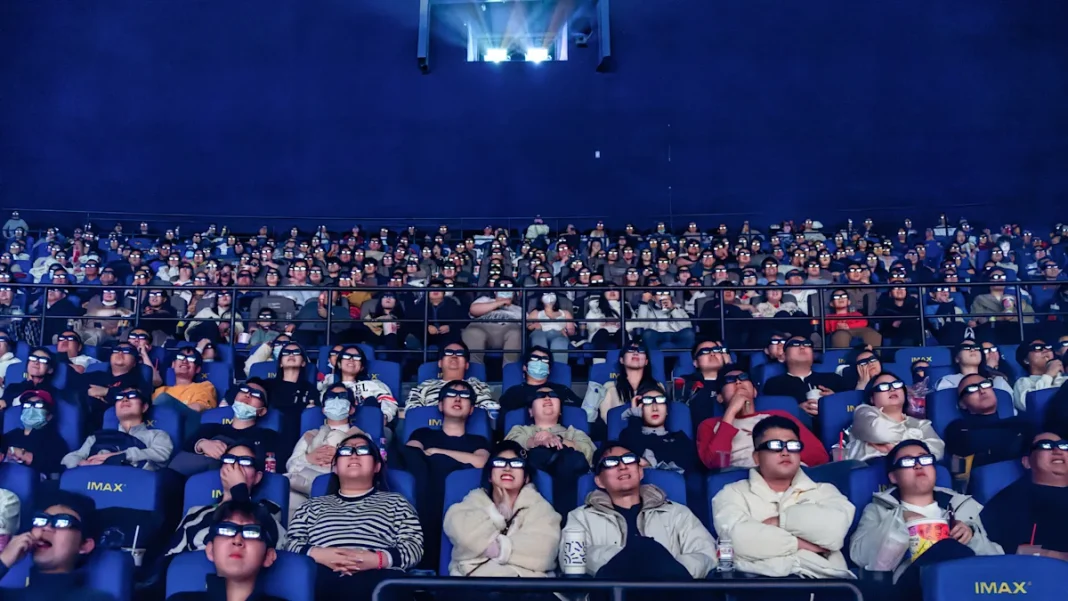
When it comes to the movie business, there’s the U.S., there’s China and then there’s everybody else. American moviegoers spent $9.1 billion at the cinema in 2023, which accounted for 27% of the total global box office that year, according to estimates by the film industry tracking firm Gower Street Analytics. China grossed $7.7 billion, 23% of the worldwide market and more than $6 billion ahead of third-place Japan.
For most of the 20th century, China’s box office was largely dormant. But then it exploded over the course of the 2010s, growing from less than $1 billion in 2011 to more than $9 billion in 2019. Hollywood films played a big role in that, as American studios harnessed the interest of China’s massive population to rake in huge receipts for its big blockbusters. Avengers: Endgame, released in 2019, grossed $632 million in China alone en route to becoming the second-biggest film of all time.
U.S. studios typically only receive about 25% of the money their films earn in Chinese cinemas, but that’s still a pretty big windfall for Hollywood when the top-line numbers can get so high.
Hollywood losing its grip
American productions aren’t earning as much as they were just a few years ago for two reasons: China’s overall movie market has shrunk considerably, and local audiences are now increasingly choosing to see homemade films over Hollywood imports.
Chinese domestic films now reportedly make up about 80% of its annual box office, up from about 60% before 2020. The extraordinary earning power of China’s homegrown film industry was put on striking display earlier this year with the release of Ne Zha 2, an animated film that has made almost $1.9 billion since it came out in late January. It is already the highest-grossing animated film ever made by any country and currently sits at No. 8 on the all-time box-office list.
Despite these shifts, though, China is still an important market for Hollywood. There were five American films that earned at least $50 million there last year — led by Godzilla x Kong: The New Empire, which made $132 million. Chinese viewers also spent $14.5 million to see A Minecraft Movie during its opening weekend last week.
Having their movies banned from China likely wouldn’t be an extinction-level event for U.S. studios, but it would be a blow for an industry that is still bringing in billions of dollars less per year than it did before COVID caused its revenue to fall off a cliff.
“Such a high-profile punishment of Hollywood is an all-win motion of strength by Beijing that will surely be noticed by Washington,” Chris Fenton, who wrote a book about Hollywood’s relationship with China, told Reuters.
Whatever China gains from even its modest rebuke of Hollywood, the U.S. just isn’t in a position to retaliate in kind. That’s because Chinese films already make next to nothing in American theaters.