
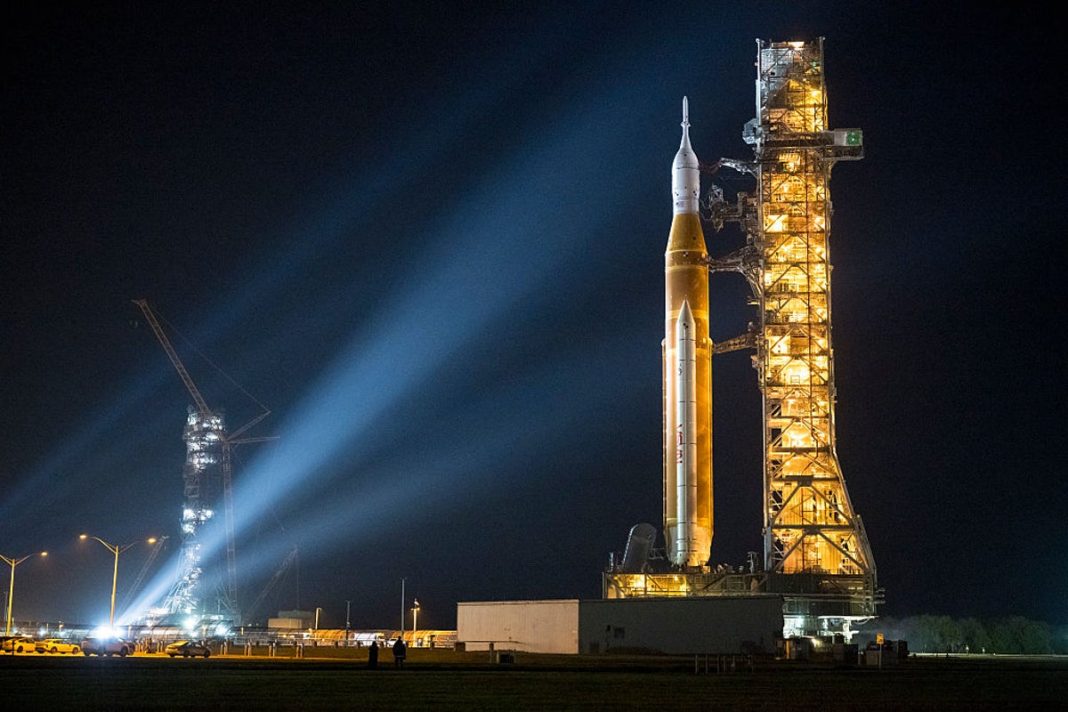

Nasa has begun the final preparations for its Artemis II mission, clearing the way for a launch on Wednesday evening.
It will be the most ambitious crewed space mission since the Apollo program more than 50 years ago, with the four-person crew set to travel around the Moon on a 10-day journey.
“The nation and the world has been waiting a long time to do this again,” mission commander Reid Wiseman told reporters from the Kennedy Space Center in Florida over the weekend.
The test mission is designed to lay the groundwork for future lunar landings, with the first one currently scheduled to take place in 2028 as part of the Artemis IV mission.
The US space agency said the current forecast for Wednesday’s launch shows an 80 per cent chance of favourable weather conditions, with potential cloud cover and high winds in the area
The four person crew consists of Nasa astronauts Reid Wiseman, Victor Glover and Christina Koch, and Canadian Space Agency (CSA) astronaut Jeremy Hansen.

Artemis II crew members CSA astronaut Jeremy Hansen, and Nasa astronauts Christina Koch, Victor Glover, and Reid Wiseman (Nasa)
They arrived in Florida on Friday, having begun their quarantine to shield themselves from viruses in Texas on 18 March.
The 10-day mission will see them fly around the Moon, taking them further from Earth than any human has ever travelled.
The trajectory of the Orion spacecraft will see it perform a high-altitude flyby of the Moon, reaching a distance of roughly 400,000 kilometres (250,000 miles) from Earth.
The previous record distance was set by Apollo 13 in 1970, when problems with the mission forced the crew to abandon its lunar landing and take a similar high-altitude trajectory around the Moon.
The Moon’s orbital position in early April means the Artemis II crew will have to travel further than the Apollo 13 crew.
There will be several other firsts for the mission, including the first woman, the first non-white person, and the first non-American to fly to the Moon.
Returning to Earth could also see a record-breaking speed for a crewed reentry, with Orion expected to reach a velocity of around 40,000kph (25,000mph).
Live coverage of Wednesday’s launch will be broadcast on Nasa’s website and official YouTube channel, starting from 7:45am local time (12:45pm BST) on 1 April, with the launch currently scheduled for 6:24pm EDT (11:24pm BST).