
Last week, Trump’s naming spree looked like a vanity move. Monday made it look like infrastructure.
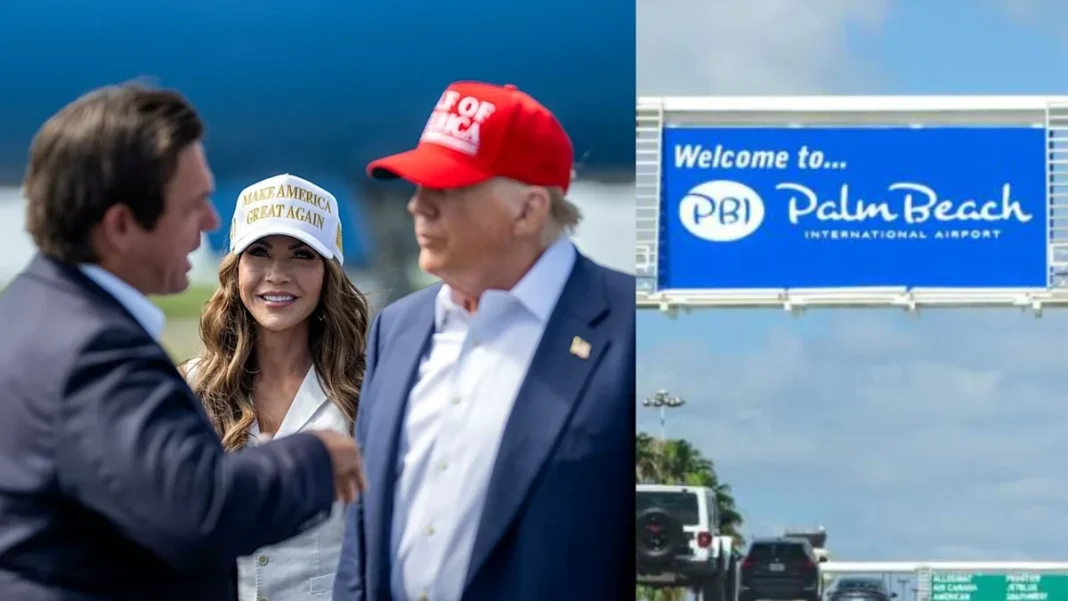
Ron DeSantis signed the bill renaming Palm Beach International Airport as President Donald J. Trump International Airport. The law takes effect July 1, includes $2.75 million in state funding for implementation, and comes months after the stretch of road linking the airport to Mar-a-Lago was already renamed President Donald J. Trump Boulevard. The airport code would change to DJT.
So the route now tells its own story. You land at Trump Airport, head down Trump Boulevard, and arrive at Trump’s private club. That is route branding, not legacy-building.

First, the boulevard. Now the airport. The route is becoming the message. Credit: The White House/Wikimedia Commons
The Trademark Is the Whole Story
CBS reported that before DeSantis signed the bill, the Trump family business had already filed trademark applications tied to the airport name. The filings, submitted in February, cover items including luggage, flight suits, and plastic shoe protectors for airport security screening. Axios reported that the filings were unprecedented for a sitting president because they do not just protect a personal name in the abstract. They seek rights around the name of a public building being sold as an honorary tribute.
The Trump Organization says it does not plan to charge royalties or collect licensing fees from the airport. But Axios quoted trademark experts saying the filings could still give the family leverage over how the name is used — fonts, logos, size, placement. The issue may not be direct profit. The issue may be control. Once a public tribute requires a legal relationship with the brand’s private owner, it stops feeling ceremonial. It starts feeling managed.

The weird part is not the rename. It is the paperwork waiting behind it. Credit: USPTO public record screenshot
The Family Was Not Standing to the Side
Eric Trump said he was “proud to have played a small role in making this happen.” That line matters. It says the family was involved enough to claim credit, and the company was active enough to file trademark paperwork while the bill was still moving through the legislature. Maybe that is smart legal housekeeping. It is also the kind of housekeeping that turns a tribute into a branded corridor.
Airports are named after presidents. That is not new. JFK, Reagan, Dulles — the precedent exists. But none of those came with trademark applications filed by the honoree’s family business before the bill was signed. None came with merchandise categories attached. And none came with a private road connecting the airport to the honoree’s personal residence, already bearing his name. The precedent covers the honor. It does not cover the infrastructure.
The Pattern Just Changed Categories
Last week, we documented the run of public institutions carrying Trump’s name or signature. The Kennedy Center. The U.S. Institute of Peace. The battleships. The gold coin. The dollar bill. Each of those could be defended individually as ceremonial. Some of them had precedent. Together, they formed a pattern. But they were all, in different ways, symbolic.
The airport is different because it touches infrastructure that people actually use. Millions of passengers a year. Rental car counters. TSA checkpoints. Baggage carousels. It is not a plaque on a building that most Americans will never visit. It is a name you will hear over the intercom every time you fly into South Florida. And unlike the Kennedy Center, this one came with trademark filings that suggest someone is already thinking about what the name is worth beyond the sign.
A Tribute Is Supposed To End With the Sign
The bill summary states that the name change is subject to an agreement with the rights holders authorizing the use of the name at no cost to Palm Beach County. That language matters. It means the county needs permission from the trademark owner to use its own airport’s name. The public facility would be named after a family whose commercial use is controlled by a private family. Even if no money changes hands, the structure of the arrangement places a private entity at the center of a public honor.
Florida Democrats say Republicans are wasting $5 million on the rename, though the bill’s current implementation funding is $2.75 million, down from earlier higher estimates. Republicans in the legislature voted 81-30 in the House and 25-11 in the Senate. The FAA says the name change is a local issue, and it will update its databases accordingly. On paper, the rename is settled. In practice, the trademark filings opened a separate question about branding and control that the bill itself did not fully foreground.
Last week, the question was how many things could carry Trump’s name. This week, the question is who gets to manage the name once it lands on something taxpayers own. At what point does a public honor stop being a tribute and start looking like inventory?