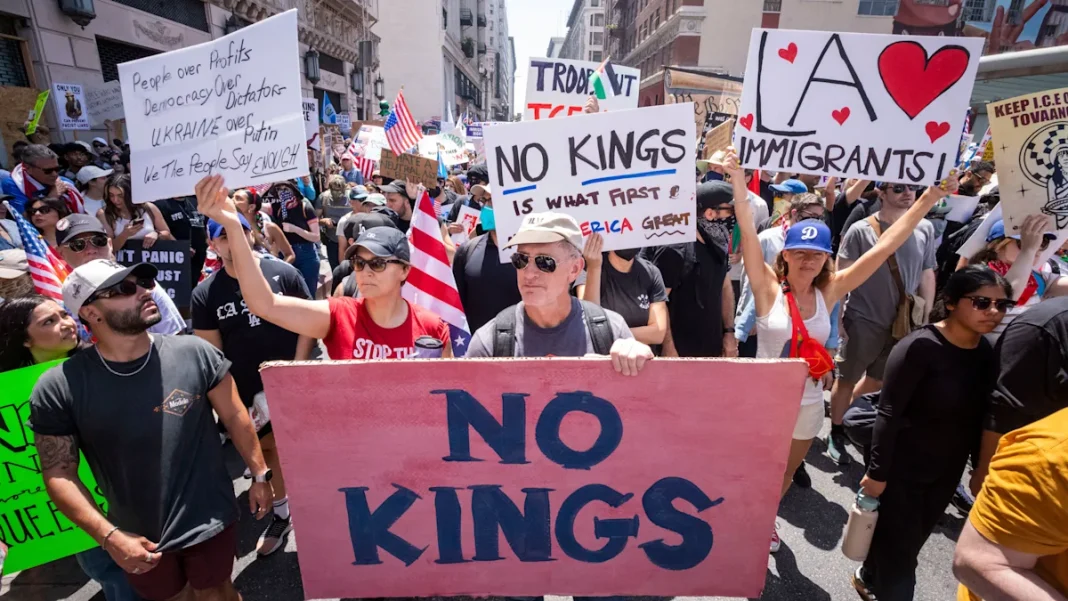

Demonstrators are gathering in thousands of locations across the United States for the third series of “No Kings” protests against the Trump administration’s policies.
Protests are already underway Saturday, with rallies kicking off from Palm Beach, Fla., to London. In Washington, D.C., thousands marched across Memorial Bridge to the Lincoln Memorial. In London, organizers claimed half a million people turned out, though police estimated closer to 50,000. The flagship Minneapolis rally with Bruce Springsteen begins this afternoon. Follow our live updates here.
More than 3,000 local events have been planned for Saturday, in what organizers say will be the largest collective protest in American history. Dozens of events have also been planned outside the U.S.
“People across the country are organizing, showing up for their neighbors, and making one thing unmistakably clear: we are done with the corruption, the cruelty, and the authoritarianism,” Ezra Levin, co-executive director of the advocacy group Indivisible, wrote in a statement earlier this month.
This is the third “No Kings” protest event since the start of President Trump’s second term. The first was held on June 14, the same day as the U.S. Army’s 250th anniversary military parade in Washington, D.C. — which was also Trump’s 79th birthday. An estimated 5 million people gathered at 2,100 locations. The second edition in October may have been even bigger. Organizers estimated that 7 million people took part, while an independent estimate put the number at between 5 million and 6.5 million.
Republicans have labeled past “No Kings” protests as “Hate America” rallies, while conservative media has highlighted scattered incidents of violent rhetoric and symbolism at the otherwise overwhelmingly peaceful demonstrations.
Here’s what to know about the events, where they’re being held and the message participants are hoping to send.
What is ‘No Kings’?
“No Kings” isn’t a single organization. Instead, it’s a coalition of liberal and progressive groups that have worked together to organize the protests. The core belief that unites all of these groups is the view that Trump has overstepped what should be the limits of his power as an elected representative of the people and has acted more like a monarch since returning to the White House.
“The president thinks his rule is absolute,” the coalition wrote on its website. “But in America, we don’t have kings — and we won’t back down against chaos, corruption, and cruelty.”
The “No Kings” website repeatedly emphasizes the need for protests to be peaceful.
“A core principle behind all No Kings events is a commitment to nonviolent action,” reads a message that appears at the bottom of every page on the site. “We expect all participants to seek to de-escalate any potential confrontation with those who disagree with our values and to act lawfully at these events. Weapons of any kind, including those legally permitted, should not be brought to events.”
Where are ‘No Kings’ protests being held?

No Kings protests locations map.
(NoKings.org)
There are protests planned in all 50 states and at least 10 European countries, plus individual events in Australia, Kenya and Ecuador. A map showing all 3,000-plus protests is available on the “No Kings” website.
Where will the biggest protests be held?
Major cities like New York, Los Angeles and Chicago are expected to host some of the largest demonstrations on Saturday. But the flagship event will be in Minnesota’s Twin Cities of St. Paul and Minneapolis, which were targeted by some of the Trump administration’s most aggressive immigration tactics early this year and were the site of two deadly shootings by federal immigration officers.
Bruce Springsteen will perform his protest song “Streets of Minneapolis” at the Minnesota state Capitol building. Singer Joan Baez, actor Jane Fonda and Vermont Sen. Bernie Sanders are also scheduled to speak at the demonstration.
What do Republicans say about ‘No Kings’?
With their attention focused on the war with Iran, chaos at America’s airports and a list of looming legislative fights, most top Republicans haven’t commented on the latest “No Kings” protests.
In the past, they have frequently labeled them as “Hate America” rallies and blamed the October events for extending the record-setting government shutdown that happened late last year. Some have also claimed, without evidence, that the demonstrations have been largely attended by paid protesters or members of antifa, a loose network of far-left groups.
Asked about Saturday’s events, White House spokesperson Abigail Jackson said Thursday: “The only people who care about these Trump Derangement Therapy Sessions are the reporters who are paid to cover them.”
What impact is ‘No Kings’ having?
It is incredibly difficult to isolate the impact of a single protest movement from the wide variety of other societal forces that influence public opinion. It’s especially hard to gauge whether protests are simply reflecting the views of the public or actually changing them.
There is evidence, though, that mass protest can make a difference. Experts say that “No Kings” fits many of the markers that successful protest movements tend to have.
“Indicators of a movement’s potential impact include its reach into uncharted territories, successful appeals to new constituencies, the ability to maintain nonviolent discipline, establishing and maintaining momentum, and the ability to elicit shifts in the behavior and priorities of those in positions of influence,” researchers from Harvard’s Nonviolent Action Lab wrote last year.
Will Saturday’s events really be the biggest protest in U.S. history?
It’s possible. There’s no real way to get a definitive count of every person who attends a “No Kings” rally somewhere in the U.S., but estimates of previous editions have put them toward the top of the list of biggest mass demonstrations ever.
Part of the answer will depend on which estimate you rely on, since organizers tend to report higher numbers than independent researchers. The definition of the word “protest” also matters. More than 20 million Americans participated in events to mark the first Earth Day in 1970. Whether they should all be considered protesters is really in the eye of the beholder.
What is very likely is that Saturday’s “No Kings” rallies, like the two previous ones, will be among the largest collective protests in the country’s history.