
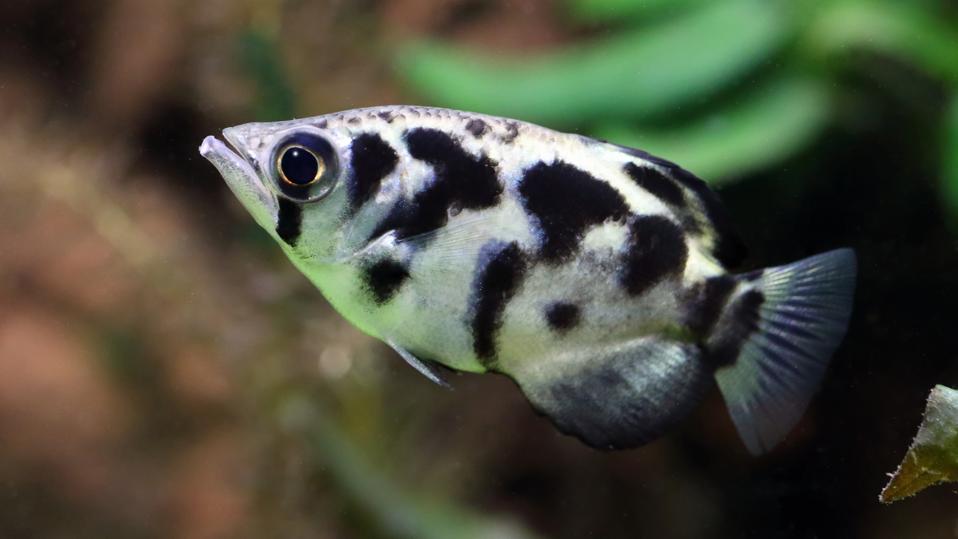

There’s something almost mischievous about the way an archerfish hunts. Instead of chasing or ambushing, it pauses beneath the water’s surface, fixes its gaze on an unsuspecting insect above — and fires. Then, a sharp jet of water arcs upward, strikes the target and sends it tumbling into the water below.
It sounds improbable. How could a fish learn how to spit at targets like a living water gun? But this behavior observed in archerfish (genus Toxotidae) is one of the most carefully studied examples of precision hunting in the animal kingdom.
Over the past few decades, controlled laboratory experiments have revealed that these fish are doing more than just “spitting” water at their prey. They are, in a very real sense, engineering a projectile. And once you look closely at how and why they do it, this fact becomes even more intriguing.
How Archerfish ‘Throw’ Water At Prey
At first glance, the mechanics seem simple: take in water, force it out, hit the insect. But the 2014 study published in Current Biology shows that the reality is far more intricate.
Archerfish generate their shots by shaping a narrow channel in their mouth. They start by pressing their tongue against a groove in the roof, before forcing water through it. This much had been known to researchers for quite some time. What the 2014 study uncovered, however, is that the fish can actively control the dynamics of the jet as it forms, adjusting the timing and shape of their mouth opening with remarkable precision.
So, instead of producing a uniform stream, what the fish actually create is a structured pulse. Water leaving the mouth later in the sequence travels faster than water at the front, so it catches up mid-flight. The result of this is a compact, high-impact “slug” of water that delivers far more force than a simple jet would.
The most important discovery that the researchers made is that this is a controlled process. That is, by modulating how quickly their mouth opens and closes, archerfish can specially tune the jet to match the distance to their target; they effectively solve a fluid dynamics problem in real time.

Archerfish (Toxotes jaculator) spitting water at insect.
getty
A striking parallel that the authors of the study draw is that the archerfish’s timing adjustment resembles the mechanics of human throwing. When we throw an object, we don’t simply release it from our hands. We have to coordinate a sequence of movements that transfers momentum efficiently from body to hand to projectile. It seems that archerfish do something analogous, albeit with water.
This finding holds provocative implications. More specifically, in humans, the evolution of throwing is something that’s linked to broader cognitive development. If precise, adaptive “throwing” confers similar demands in archerfish, then this may help explain why these fish exhibit unexpectedly advanced perceptual and motor abilities for their size.
(If you want a clearer sense of just how advanced we’re talking, read here about how archerfish can recognize and remember individual human faces.)
Why Do Archerfish Need To Shoot Water?
The obvious question surrounding archerfish is: why bother? Virtually every other species of fish on the planet has survived without the need for hydrodynamic water jets. What makes archerfish different?
The answer lies just above the waterline. Archerfish are known inhabitants of mangroves, where branches and leaves teem with insects. These insects represent a rich, energy-dense food source. However, they’re also, quite literally, out of the fish’s reach.
If this weren’t challenging enough already, a 2012 study published in PLOS One highlights an extra constraint that archerfish face: these insects aren’t loosely perched. They are often firmly anchored to vegetation, with attachment forces that can reach ten times their body weight. In other words, simply nudging them, or even just striking them weakly, wouldn’t suffice.
In order to access this food source, this means that archerfish need to generate enough force to overcome those anchoring forces. And that is precisely what their water jets are designed to do.
By producing a focused, high-impact pulse, archerfish can dislodge insects that would otherwise remain securely attached. For this reason, the pulse needs to be both accurate and powerful enough to strike the target and, more importantly, to break its strong grip on the substrate.
Then, once the insect is knocked free, gravity does the rest. It falls into the water — into the fish’s domain — where it can then be quickly consumed. This strategy sidesteps several survival challenges all at once:
-
It eliminates the need to leap out of the water, which would be energetically costly and potentially dangerous
-
It allows the fish to exploit a food source unavailable to most aquatic competitors
-
It converts a spatial problem (“the prey is above me”) into a mechanical one (“I can bring it down”)
Archerfishes’ Evolutionary Advantages
Over time, even small evolutionary advantages can accumulate into transformative adaptations. In the case of archerfish, their shooting behavior likely opened up a niche that few other fish could access.
Mangrove ecosystems are crowded with fish that have to compete for food within the water. Now imagine a subset of those fish that can reliably harvest insects from above the surface — a largely untapped resource. The payoff is obvious: less competition, more consistent nutrition and access to high-energy prey. However, the advantage doesn’t end with access to prey. The way archerfish exploit it compounds their success even further.
The first and most instrumental advantage is that the method is repeatable and scalable. A fish can fire multiple shots in succession, and it can adjust relatively effortlessly for distance and target size. This flexibility means they aren’t limited to a narrow set of conditions; they can hunt across varying environments and prey types.
Secondly, the behavior likely gave rise to improvements in perception and motor control. Accurately hitting a target above water would require archerfish to compensate for the distortion of light at the air–water interface; they’d also need to judge distance while timing the shot perfectly. Individuals better at these tasks would’ve had a clear advantage. This created a feedback loop between ecological opportunity and cognitive refinement.
Lastly, and perhaps most importantly, it’s a low-risk-high-reward system. Unlike jumping or surface strikes, spitting water allows the fish to stay submerged and relatively protected from predators. It is a way of interacting with the world above water without fully entering it.
Together, these factors point to the archerfish’s signature behavior being a key innovation in marine biology. It allowed the species to expand into a new ecological space, and in doing so, likely shaped the evolution of its sensory and motor systems.
Archerfish remind us that intelligence in the natural world often hides in plain sight. A small fish beneath the surface, spitting water at insects, might not seem like much at first glance. But look closer, and you find a system that blends physics, perception, and behavior into something unexpectedly sophisticated. That’s not bad for a creature that never leaves the water; somehow, it learned to reach beyond it.
Watching the archerfish hunt is a reminder of nature’s hidden brilliance. Take the Connectedness to Nature Scale to measure your own connection to it.
This article was originally published on Forbes.com