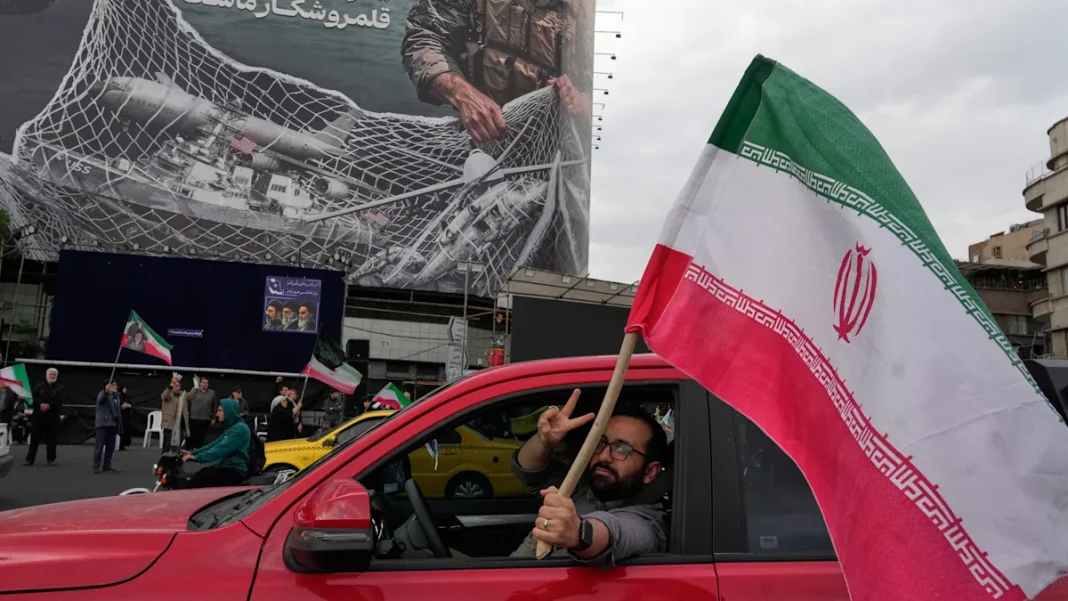

A 10-day ceasefire has gone into effect in Lebanon, starting at midnight local time on Friday.
“I just had excellent conversations with the Highly Respected President Joseph Aoun, of Lebanon, and Prime Minister Bibi Netanyahu, of Israel,” President Trump wrote on social media. “These two Leaders have agreed that in order to achieve PEACE between their Countries, they will formally begin a 10 Day CEASEFIRE at 5 P.M. EST.”
The truce between the governments of Israel and Lebanon comes nine days after the U.S. and Iran agreed to a two-week ceasefire in hopes of negotiating a permanent end to the war that has engulfed the Middle East since late February.
Does that mean the war is about to end? Not quite. But there’s been some movement in recent days.
Vice President JD Vance traveled to Pakistan on Saturday for the United States’ first direct meeting the U.S. has had with Iran in more than a decade. Officials from Israel and Lebanon met in Washington, D.C., on Tuesday. The Strait of Hormuz — the critical oil shipping route that’s taken center stage since Iran blocked it off at the start of the conflict — has become an even bigger sticking point. And while the global economic picture is looking gloomy, the stock market has been hitting record highs.
Throughout the week, President Trump has been expressing optimism that a deal to end the war is within reach. He told the New York Post on Tuesday that additional U.S.-Iran peace talks “could be happening over the next two days” in Islamabad.
“I think you’re going to be watching an amazing two days ahead,” Trump told ABC News reporter Jonathan Karl in a separate phone interview.
In a post on Truth Social on Wednesday, Trump claimed that China has agreed not to send weapons to Iran amid reports Beijing has weighed transfers of arms to Tehran.
And in a sit-down interview with Fox Business host Maria Bartiromo that was taped on Tuesday and aired on Wednesday, Trump said he thinks the Iran war is “close to over” and “can be over very soon.”
“It will end soon,” the president said.
Here’s everything you need to know to catch up.
Are the U.S. and Iran making progress in peace talks?
Over the weekend, Vance and U.S. negotiators Steve Witkoff and Jared Kushner spent 21 hours in Islamabad pushing for a peace deal with their Iranian counterparts. When they left, Vance tersely announced that the two sides had not reached an agreement because Tehran had “chosen not to accept our terms.”
“We’ve made very clear what our red lines are,” Vance said at the time. “We need to see an affirmative commitment that they will not seek a nuclear weapon, and they will not seek the tools that will enable them to quickly achieve a nuclear weapon.”
Trump insisted he was fine with that outcome. Iran’s “military is gone,” he told reporters at Joint Base Andrews in Maryland on Sunday, and “their missiles are largely depleted.”
“I don’t care if they come back [to the negotiating table] or not,” the president added. “If they don’t come back, I’m fine.”

Men walk past the remnants of a building in Tehran.
(Majid Saeedi/Getty Images)
But since then, reports have suggested that Tehran and Washington may not be as far apart on nukes as it originally seemed. According to the New York Times, the U.S. is no longer insisting that Iran end its nuclear program forever. Instead, Vance and his team “proposed a 20-year ‘suspension’ of all nuclear activity” along with the removal of “970 pounds of near-bomb-grade uranium from the country, to ensure it could never be diverted to a bomb project.”
In response, Iran “renewed a proposal that it suspend nuclear activity for up to five years” and offered to “dilute” its fuel stockpile “significantly so that it could not be used to produce a nuclear weapon.”
The fact that the U.S. is now discussing a time period for suspending nuclear activity — rather than insisting it come to a permanent stop — “suggests that there may well be room for a deal,” according to the Times.
There are elements at play here: Tehran had also demanded control of the Strait of Hormuz, payment of war reparations and the ceasefire in Lebanon, according to Iranian state TV and officials. But the nuclear issue is the toughest, and if Trump can get the Iranians to agree to something he can sell as a “better” deal than the one struck by the Obama administration in 2015 — a deal he scuttled during his first term — then he may very well accept it.
Speaking to the New York Post on Tuesday, Trump pushed back on the idea of a 20-year moratorium. “I’ve been saying they can’t have nuclear weapons,” he said, “so I don’t like the 20 years.”
“I don’t want [Iran] to feel like they have a win,” he added.
But the president confirmed reports that Pakistan is working to organize a second round of direct negotiations this week. Pakistan said it was organizing those talks on Thursday, but declined to give a date for when they’d occur, according to the Times.
On Wednesday, Axios reported that U.S. and Iranian negotiators were continuing to make progress — “moving closer to a framework agreement to end the war” through phone calls, draft proposals and backchannel communications. Axios reported that the current ceasefire could be extended to accommodate a possible agreement, but White House press secretary Karoline Leavitt said that was “not true at this moment.”
On Thursday, Trump told reporters that Iran had “agreed to give us back the nuclear dust,” adding that he might travel to Pakistan if an Iran deal “is signed in Islamabad.”
“They’re willing to do things today that they weren’t willing to do two months ago,” the president said, without elaborating further.
Is the Strait of Hormuz open or closed?
When Trump announced the ceasefire last Tuesday, he wrote on social media that it was “subject to the Islamic Republic of Iran agreeing to the COMPLETE, IMMEDIATE, and SAFE OPENING of the Strait of Hormuz” for two weeks.
But hours later, Iranian state media said Tehran had turned some tankers away and “fully closed” the strait again. Confusion ensued. Iran seemed to have stopped laying mines and attacking vessels, and the regime said it would allow for safe passage if ships coordinated with the country’s armed forces to avoid existing mines.

Cargo ships near the Strait of Hormuz.
(Stringer/Reuters)
At the same time, however, Tehran insisted that if the strait were to fully reopen, Israel must stop bombarding the Iranian-backed militant group Hezbollah in Lebanon — a contentious issue that threatened to derail the ceasefire. The regime also demanded formal control over Hormuz going forward, with a reported toll of $2 million per vessel.
When talks in Islamabad ended without a deal, Trump decided to counter with a blockade of his own. “Effective immediately, the United States Navy, the Finest in the World, will begin the process of BLOCKADING any and all Ships trying to enter, or leave, the Strait of Hormuz,” Trump posted Sunday on social media.
“Their promise was that they were going to open the Hormuz Strait,” Trump told reporters later that day. “They didn’t do it. They lied.”
The idea of a U.S. naval blockade is simple: If Iran won’t let other ships carrying cargo from other countries cross the strait, then ships carrying Iranian cargo can’t cross either. The goal is to increase economic pressure on the regime in order to force concessions at the negotiating table.

U.S. warships around the Strait of Hormuz.
(Yasin Demirci/Anadolu via Getty Images)
In practice, however, the picture is a lot murkier. According to the New York Times, tracking data showed that several ships had passed through the strait before and after Trump’s Monday morning deadline — some of which “had departed from Iran, were carrying Iranian products or were under U.S. government sanctions.”
Late Tuesday, the U.S. military said that its blockade “has been fully implemented” and that U.S. forces “have completely halted economic trade going into and out of Iran by sea.”
In the first 24 hours, six vessels turned around after being issued warnings, according to U.S. officials.
On Wednesday, U.S. Central Command said that no commercial vessels entering or exiting Iranian ports had evaded the U.S. naval blockade in its first 48 hours. Kpler, a maritime data company, noted in a report that several vessels seemed to stop or slow down after exiting the Strait of Hormuz into the Gulf of Oman, “which may reflect the deterrent effect of the blockade.”
In response, Iran threatened to halt all trade in the region. “Iran’s powerful armed forces will not allow any exports or imports to continue in the Persian Gulf, the Sea of Oman and the Red Sea,” the major general who oversees Iran’s army and Revolutionary Guard told state media. It’s unclear how Iran plans to enforce this threat.
On Thursday, Central Command said that 14 vessels had complied with the blockade and turned around at the direction of U.S. forces.
What about Israel and Lebanon?
As Israel’s military campaign in Lebanon continued to threaten the U.S.-Iran ceasefire, the two countries’ ambassadors to the U.S. gathered in Washington on Tuesday for talks about how to bring “a permanent end to 20 or 30 years of Hezbollah influence,” in the words of Secretary of State Marco Rubio.
It was a rare meeting between two countries that have been at odds for decades and do not have diplomatic relations. Hostilities between Israel and Hezbollah, an Iranian-backed militant group in Lebanon, have flared up intermittently since 1982. Hezbollah launched several rockets into northern Israel after the U.S. and Israel struck Iran on Feb. 28. Israel has been conducting retaliatory strikes on Hezbollah targets in Lebanon ever since.

Secretary of State Marco Rubio, center.
(Andrew Harnik/Getty Images)
Yet, Israeli Ambassador Yechiel Leiter struck a positive note after the meeting, saying both sides are “united in liberating Lebanon” from Iranian influence. “We discovered today that we are on the same side of the equation,” Leiter said. He also told Israeli reporters that the Lebanese government had expressed a “strong desire” to fully disarm Hezbollah.
Initially, prospects for peace seemed somewhat remote. Netanyahu insisted that a ceasefire with Hezbollah was not on the table — and statements from the Israeli military on Tuesday suggested that its campaign in southern Lebanon was continuing in full force.
“This is a process, not an event,” Rubio said at the start of Tuesday’s talks, which he attended. “All of the complexities of this matter are not going to be resolved in the next six hours.”
But after the meeting, Israel and Lebanon praised the “productive discussions” between their ambassadors and agreed to “launch direct negotiations” in the days ahead.
On Wednesday, the New York Times reported that Israel was considering a short-term ceasefire in Lebanon. Two Israeli officials said the pause “could begin as early as Thursday and last about a week.”
After Trump announced the ceasefire on Thursday, Netanyahu described it as “an opportunity to forge a historic peace agreement” between his country and Lebanon. To do so, he said, Hezbollah would have to be disarmed. And Israeli troops would remain in southern Lebanon in the meantime as part of an “expanded security zone,” he added.
Hezbollah acknowledged the ceasefire but said its actions would be “based on how developments unfold.” The Lebanese government does not have direct control over the militant group.
Are oil and gas prices going down yet?
After weekend peace talks broke down and Trump announced his own Hormuz blockade, oil prices jumped above $100 per barrel — then dipped slightly as the possibility of more talks emerged.
As of Wednesday, the U.S. average gas price had fallen a few cents from recent highs to $4.09 a gallon. But experts say that prewar, $3 gas is unlikely to return anytime this year. Even Trump predicted on Sunday that gas prices could be “the same, or maybe a little bit higher” by November’s midterm elections.
Meanwhile, the International Monetary Fund warned in a new report released on Tuesday that disruptions to oil markets could slow growth, fuel inflation and raise the possibility of a global recession this year. In its best-case scenario — a quick end to the war — the IMF said global growth would slow from 3.4% to 3.1%, while oil prices would rise by more than 21%. In its worst-case scenario, global growth would plummet to 2.4% and inflation would soar to 6%.
“The global outlook has abruptly darkened following the outbreak of war in the Middle East,” Pierre-Olivier Gourinchas, chief economist of the IMF, wrote in the report. “The downside risks are tremendous.”