

A 77-year-old school set among hemlock trees and vernal ponds in a North Jersey state forest — and a much-needed destination away from whiteboards and walls for children in the districts that use it — is asking the public to help restore state funding or risk closing its doors.
The New Jersey School of Conservation in Sussex County’s Stokes Forest will see its funding eliminated if Gov. Mikie Sherrill’s 2026-27 budget proposal passes unchanged, executive director Kerry Kirk Pflugh told NorthJersey.com.
Representatives of the school, founded in 1949, made an urgent request to restore its funding during a March 24 public hearing on the budget with state senators in Trenton, Kirk Pflugh said. They have also launched an online petition to drum up public support.
Story continues below photo gallery
Though little-known, the school offers K-12 school field trips and is one of the nation’s oldest, year-round residential environmental education centers, Kirk Pflugh said.
A typical day spent at the school by middle schoolers consists of pulling on galoshes and wading into a stream with a magnifying lens, or collecting water samples on Lake Wapalanne, followed by a visit to the Big Flat Brook, which is ranked among New Jersey’s cleanest waterways, said Kirk Pflugh.
“We go into the stream and look under rocks for macroinvertebrates like caddisflies, mayflies, and dragonflies in their nymph stage, before they are fully grown and begin to fly across the river in their many colors,” she said.
Research consortium with Rutgers, Princeton, Ramapo
The school participates in a research consortium with Rutgers University and eight universities, including Princeton University and Ramapo College, and is home to a music camp for teens run by Montclair State University that has brought pianists, orchestra and jazz musicians and their instruments to the forest every July since the late 1990s.
The school also provides professional development for K-12 teachers in public and charter schools on incorporating climate change instruction into their classwork through a collaboration with the state and Ramapo College.

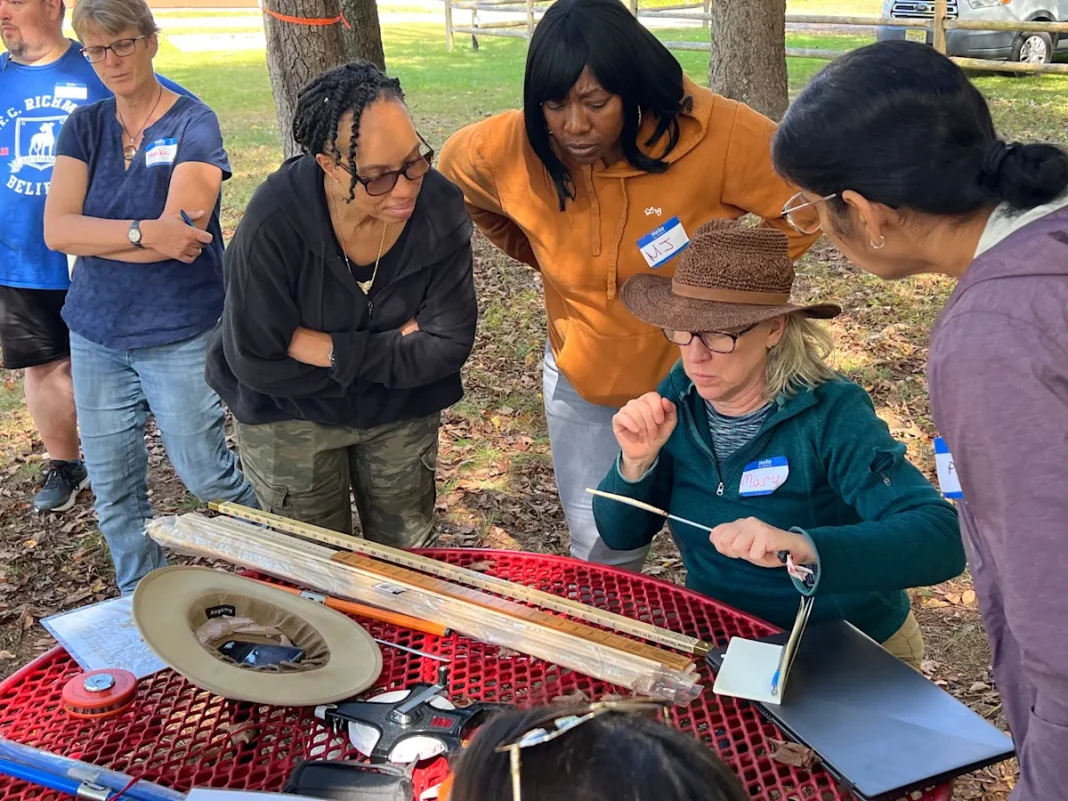
K-12 teachers attending professional development workshops as part of the state’s climate change learning collaborative through a program between Ramapo College and the New Jersey School of Conservation in Stokes Forest.
If the state aid cut occurs, “it will not only end a legacy of world-class environmental education, but it will also trigger a series of responsibilities that the state is ill-prepared to manage,” Kirk Pflugh told lawmakers.
The nonprofit that runs the school, Friends of NJSOC, formed by supporters like Kirk Pflugh, whose father was a former director, manages the upkeep of its 63 buildings on a 240-acre tract as well as its programming.
The group is requesting $3 million in Sherrill’s final FY2027 budget.
A little more than half of the districts using School of Conservation programs last year were Title 1 districts, she said, including Jersey City, Paterson and Newark. Title 1 districts have large low-income populations and receive additional federal funding. There are 60 schools from 15 counties that use the school’s on-site programs, according to Kirk Pflugh.
Could close by end of summer
Without funding, the school could close at the end of summer, she said, returning control of its buildings and land to the state in the middle of a 20-year lease. The school will have to lay off its 30 employees, many of whom are science educators who teach the on-site classes.
Funding for the school has typically come through a grant-in-aid from the state Department of Environmental Protection, Kirk Pflugh said.
“We have always received some amount of funding,” Kirk Pflugh said. “That varied from year to year.”
Though funded by the state through different channels since 1949, a state law signed by former Gov. Phil Murphy in 2022 mandated annual funding to the school for environmental field study.
The governor’s office and state Department of Environmental Protection did not immediately respond to a request for comment.
This article originally appeared on NorthJersey.com: NJ School of Conservation could close without state aid