Sunday, April 19, 2026
7.2 C
London

Putin finally admits Russia’s economy is in trouble and grasps for answers, after warnings about a financial crisis have been piling up


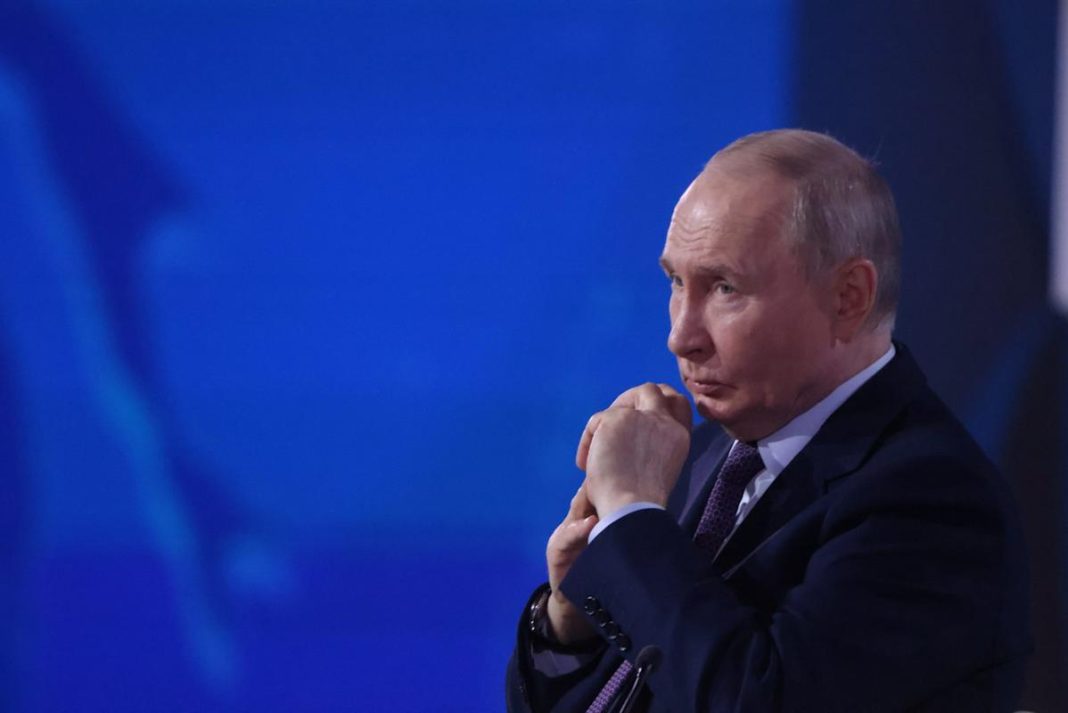
Russian President Vladimir Putin made his concerns about the economy public as he vented frustration at aides and demanded they come up with solutions.

During a televised meeting on the economy Wednesday, he revealed that GDP shrank by combined 1.8% in January and February, adding that manufacturing, industrial production and construction were negative.

“I expect to hear detailed reports today on the current economic situation and why the trajectory of macroeconomic indicators is currently below expectations,” Putin said. “Moreover, below the expectations of not only experts and analysts, but also the forecasts of the government itself and the central bank of Russia.”

The meeting was attended by Prime Minister Mikhail Mishustin, Kremlin Deputy Chief of Staff Maxim Oreshkin, First Deputy Prime Minister Denis Manturov, Deputy Prime Minister Alexander Novak, Central Bank Governor Elvira Nabiullina, and ​the CEO of PSB ​bank.

Russia’s economy had already been slowing down as Putin’s war on Ukraine continues to keep inflation high and the labor market tight.

An economic contraction would be the first since 2022, when Russia invaded Ukraine and was hit by Western sanctions that slashed energy exports.

Massive military spending helped GDP expand by 4.1% in 2023 and 4.9% in 2024. But weak oil revenue and deeper deficits forced Moscow to limit defense outlays. GDP grew by just 1% last year, and the Kremlin earlier predicted 1.3% growth this year.

Meanwhile, the Kremlin’s budget deficit widened to $58.6 billion in the first quarter as oil tax revenue in March dropped by half compared to a year ago.

To be sure, the Iran war sent oil prices soaring, and the Trump administration has lifted sanctions on Russian oil, setting up Moscow for a revenue windfall. But Ukraine’s relentless drone attacks on Russian export hubs have prevented Russia from fully capitalizing on its opportunity.

Following Putin’s scolding of his aides on Wednesday, the central bank chief said Thursday that Russia’s unemployment rate remained at a historic low of 2% as the war created a lack of available workers, forcing employers to compete for staff.

“The peculiarity of the current situation is that for the first time in modern history, our economy has ‌faced shortages or limits on labor,” Nabiullina added. “This is a new reality for the government and for business alike. In the past, high-rate cycles were tied to temporary external shocks, and once things stabilized, we cut rates fairly quickly. Now, however, we are facing a persistent downturn in external conditions affecting both exports and imports.”


The tight labor market has stoked inflation and kept benchmark interest rates high. Although the central bank has recently eased them a bit, they have caused strains in the economy and financial system, prompting a series of warnings.

Earlier this year, Russian officials told Putin that a financial crisis could hit by the summer amid spiraling inflation. With companies feeling the squeeze of high rates and weaker consumption, more workers were going unpaid, getting furloughed, or seeing their hours cut. As a result, consumers were having trouble servicing their loans, raising concerns of a crash in the financial sector.

“A banking crisis is possible,” a Russian official told the Washington Post in December on condition of anonymity. “A nonpayments crisis is possible. I don’t want to think about a continuation of the war or an escalation.”

The Center for Macroeconomic Analysis and Short-Term Forecasting, a state-backed Russian think tank, also said in December the country could face a banking crisis by October if loan troubles worsen and depositors pull out their funds.

In June, Russian banks raised red flags on a potential debt crisis as high interest rates weigh on borrowers’ ability to pay off loans. Also that month, the head of the Russian Union of Industrialists and Entrepreneurs warned many companies were in “a pre-default situation.”

This story was originally featured on Fortune.com


.

Hot this week

president struggles to reopen strait as Iran rejects US blockade

Donald Trump hopes of extricating himself from his war...

Frost Advisory, Freeze Watch to start overnight for some

A Frost Advisory will go into effect for Mercer,...

Construction on Trump’s White House ballroom can continue for now, US appeals court says

WASHINGTON (AP) — A federal appeals court is allowing...

Topics

president struggles to reopen strait as Iran rejects US blockade

Donald Trump hopes of extricating himself from his war...

Frost Advisory, Freeze Watch to start overnight for some

A Frost Advisory will go into effect for Mercer,...

Construction on Trump’s White House ballroom can continue for now, US appeals court says

WASHINGTON (AP) — A federal appeals court is allowing...

Beloved NKY LGBTQ+ leader Katie Meyer dies at 41

A beloved Cincinnati-area LGBTQ+ leader has passed away, officials...

Trump, IRS In Talks To Settle U.S. President’s $10 Billion Lawsuit

April 17 (Reuters) - Lawyers for Donald Trump and the Internal Revenue Service...
spot_img

Related Articles

Popular Categories

spot_imgspot_img