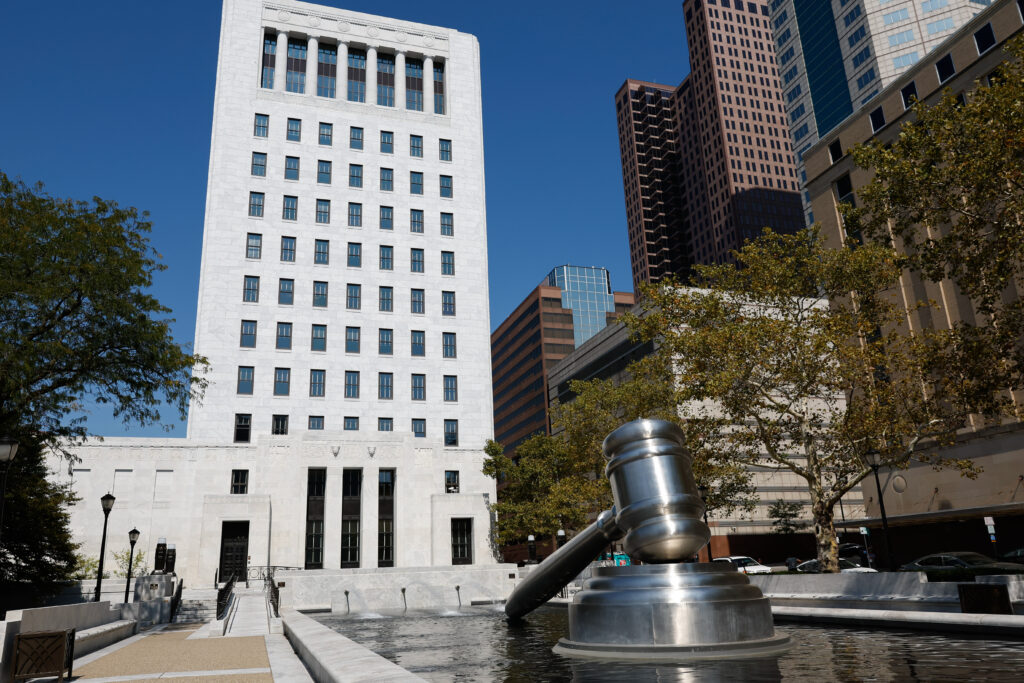

Essentially the Ohio Supreme Court, without benefit of briefs, a full hearing, or public feedback, just decided Ohio is now the only state in the nation that permits judges to make partisan endorsements.
– Catherine Turcer, Executive Director of Common Cause Ohio.
You read that right. Ohio’s highest court issued an out-of-the blue ruling with profound implications for an even more partisan judiciary in the state.
In a 5-1 Republican majority opinion, the justices made Ohio a complete outlier in the country by ending a decades-old ban on state judges and judicial candidates openly endorsing (or opposing) a candidate for another public office.
The point of the ban was that allowing such endorsements would blur the distinction between judges and other elected officials, explained law professor Jonathan Entin from Case Western Reserve University.
“The idea of an independent and impartial judiciary assumes that judges are not simply politicians in robes,” he said.
Republican Chief Justice Sharon Kennedy wrote the majority opinion joined by Republican Justices Pat DeWine, Joe Deters, Dan Hawkins, and Megan Shanahan. Democratic Justice Jennifer Brunner did not participate in the decision.
When a judge participates in another person’s political campaign, wrote the lone dissenting Republican Ohio Supreme Court Justice Patrick Fischer, his impartiality can be questioned and public faith in the judiciary’s “ability to abide by the law and not make decisions along political lines” can be lost.
Yet without warning, the state supreme court dropped a legal bombshell on April 2 that changes everything for anyone with business before judges suddenly free to shed the appearance of impartiality and stump for other candidates with impunity.
“They can now be just as partisan as the gubernatorial candidates,” said Turcer.
What is almost as stunning as the court clearing judges to give full-throated campaign endorsements of, say, prosecutors, sheriffs, legislators, or lawyers — who may later come before them in court and trigger systemwide recusals?? — is that the justices repealed the ethical restriction on that judicial political activity without ever being asked to by the parties before the bench.
The majority, said an incredulous Fischer, advocated independently for a drastic change in the law — striking a venerable judicial rule established by the court — “based entirely on a constitutional argument that was never raised or briefed but was actively waived” by both parties in the dispute.
Whatever possessed Republican justices, save Fischer, to go rogue on normal operating procedures to concoct their own case about how judges and judicial candidates have free speech rights to make partisan endorsements?!
Compelling state interest to preserve public confidence in an impartial, independent judiciary was duly noted by the Republican panel but only to a point.
“Judges do not give up their First Amendment right to engage in political speech simply by assuming office,” said Chief Justice Sharon Kennedy in the majority opinion.
The current prohibition on a judge’s endorsement or opposition to candidates for public office, she asserted, without any briefing on the issue or allowing interested parties through friend of the court briefs to be heard, was “vastly overinclusive.”
The rule, Kennedy wrote, is not “tailored to serve a compelling state interest,” so she conveniently got rid of it in a disciplinary case against now-retired Clinton County Common Pleas Judge John Rudduck, accused of violating the anti-endorsement ban in the code of judicial conduct with social media posts about his candidate son.
Instead of dispatching with the matter in the usual way, the court used the disciplinary counsel’s complaint against Rudduck to summarily scrap the 70-year-old ban on judges endorsing other political candidates on First Amendment grounds.
“Extremely unusual” detour, stressed former Ohio Supreme Court Justice Michael Donnelly. “In this case the court acted as petitioner, decider, and potential beneficiary.”
The justices issued a ruling “that affects them, that lifts a long-standing restriction against them,” the shocked jurist said.
And they did so without crucial adversarial or supplemental briefings from parties in the dispute.
Fischer echoed Donnelly’s disbelief over the majority’s flagrant judicial activism in “raising, arguing, and adjudicating an unbriefed, unraised constitutional” question “without any input from or notice to, the parties involved, the judges and judicial candidates in Ohio’s 88 counties, the members of the Ohio bar, or the public at large.”
Moreover, Fischer wrote, “the majority overlooks the fact that any constitutional issue was explicitly waived by the parties filing their joint waiver of objections.”
Even the judge accused of a breach of ethics, which he denied, did not challenge the constitutionality of the anti-endorsement rule.
Rudduck waived his right to object in writing when the disciplinary board’s findings of fact, conclusions of law and recommended sanctions were submitted to the Ohio Supreme Court for final arbitration.
“Usually, the sole issue before us then,” Donnelly told me, “is what recommendations do we want to side with on the consequences” of the alleged transgression.
“If you’re a judge or lawyer charged at the Board of Professional Conduct with misconduct, you’re afforded major due process to defend yourself on those allegations. So very rarely do you see the court actually vacating a finding after all that process.”
But rather than decide whether the suggested punishment (a public reprimand) fit the offense before the court, the Republican majority swerved unexpectedly into a broad constitutional ruling about the anti-endorsement ban itself.
Rudduck was off the hook, said the justices, because the ban was unconstitutional.
No other court has ruled likewise, and several federal appeals courts have judged the opposite; the First Amendment does not protect judges’ right to make partisan endorsements.
But Ohio’s supreme court chose to deviate from volumes of legal precedent, sanction the partisan proclivities of supposedly impartial judges, and open a can of worms.
“Who is ever going to believe you get a fair day in court” sighed Turcer.
SUBSCRIBE: GET THE MORNING HEADLINES DELIVERED TO YOUR INBOX
SUPPORT: YOU MAKE OUR WORK POSSIBLE